

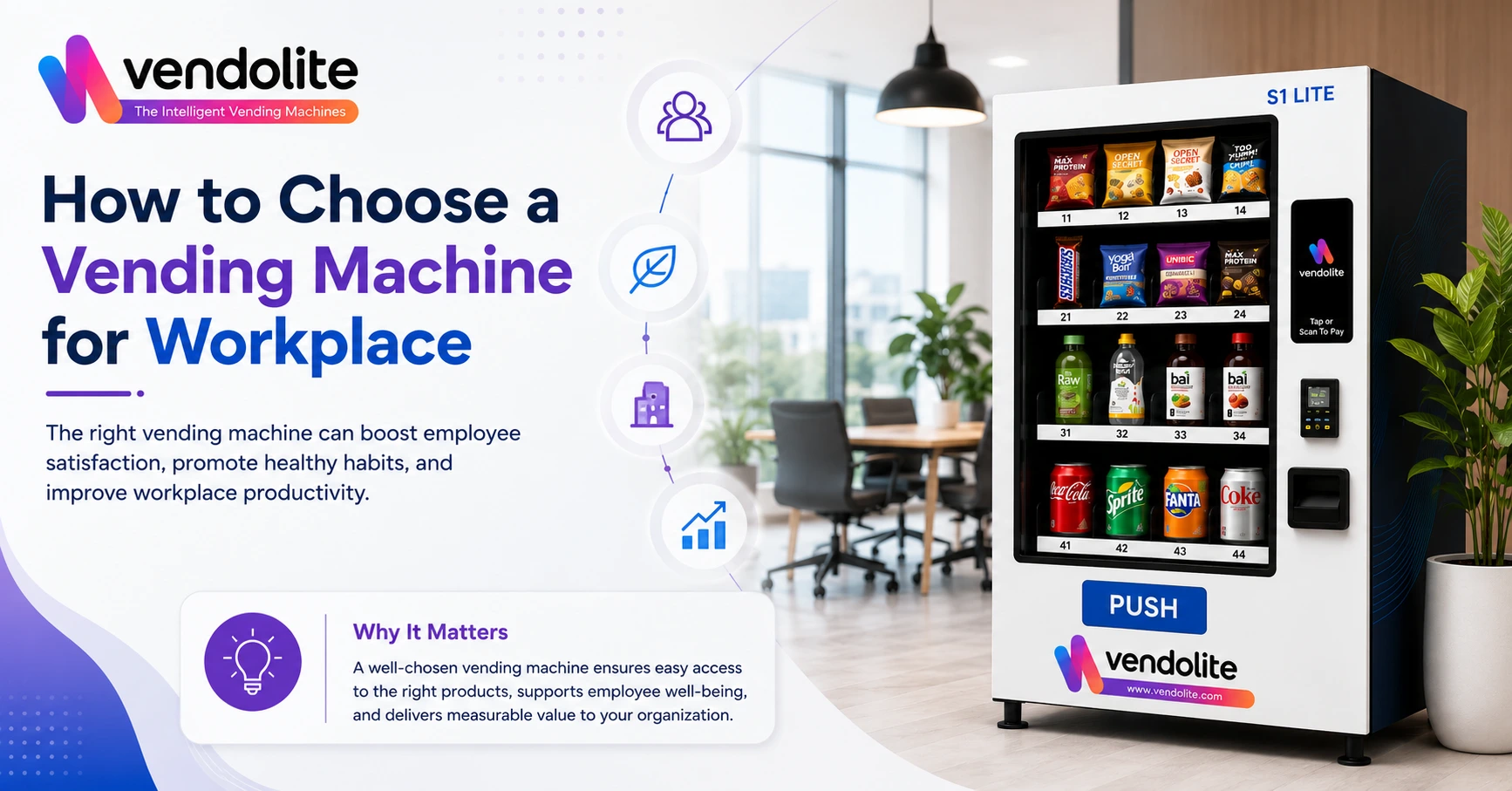
A vending machine for workplace use sits at an unusual intersection of facilities decision, part HR perk, part operational expense. The wrong choice gets ignored or breaks down within months. The right one quietly improves break-room flow, employee retention, and even how a team feels about coming into the office. In 2026, the gap between a good and a poor selection has widened sharply. Cashless adoption now exceeds three-quarters of all vending transactions in most workplaces, machines report inventory and faults in real time, and revenue-share contracts have shifted in ways that change who actually profits.
capacity matched to headcount, the service model (managed, micro-market, or self-operated), payment technology, telemetry and remote monitoring, energy efficiency, reliability commitments from the operator, and contract terms. Get those right, and the rest of the product mix, restocking schedule, and even placement tend to follow naturally. Skip one, and the consequences usually show up within ninety days. A well-chosen vending machine for workplace use should clear all seven hurdles, not just three or four.
The single most common mistake is buying a business for the company that it will be in two years, not the one it is today. A thirty-person office doesn’t generate enough vend sales to keep a forty-five-selection machine fresh; stock turns slowly, products approach their expiry, and the unit starts to feel stale within a quarter. A rough industry rule, echoed across operators of all sizes, is one combination unit per seventy-five to one hundred employees, with a separate cold-drink machine added once daily traffic comfortably exceeds that mark.
Traffic pattern matters as much as raw headcount. A round-the-clock manufacturing facility with three shifts of forty needs a sturdier, higher-capacity machine than a one-hundred-and-twenty-person office that empties at six in the evening, because night and swing-shift workers have nowhere else to buy food. Most managed operators require a minimum of forty to fifty employees on-site before placing a machine at no upfront cost below that threshold; purchase or lease becomes the only realistic route. A vending machine for workplace use in a shared coworking environment behaves differently again: members are price-sensitive, transient, and far less tolerant of stockouts than employees of a single company.
When evaluating a vending machine for workplace deployment, the service-model decision drives more downstream consequences than any other single choice. Three models dominate the market, and each shifts the balance of upfront cost, ongoing work, and control in a different direction.
Under a managed arrangement, an operator owns the machine, installs it, stocks it, services breakdowns, and pays the host business a commission on sales, typically ten to twenty percent of gross revenue, sometimes higher in high-traffic locations. There is no upfront cost beyond electricity, which runs roughly ₹2,800 to ₹5,500 a month per machine in most markets. The host gives up some control over the product mix, but a good operator updates planograms based on sales data and adjusts to feedback. According to the National Automatic Merchandising Association, managed service accounts for the majority of workplace vending placements globally, and the share is growing as small and mid-sized employers increasingly prefer hands-off arrangements.
A micro-market replaces the locked machine with open shelves, coolers, and a self-checkout kiosk. Margins are higher, selection is broader, and employees consistently report preferring them — but they only work in secured spaces where shrinkage stays low. Below roughly one hundred and fifty employees, the economics rarely justify a micro-market unless the operator offers a hybrid solution.
Buying a machine outright (₹2 lakh to ₹7.5 lakh new, less for refurbished units) gives the host full control over products and pricing. Leasing typically runs ₹4,500 to ₹18,000 a month. Both models put the labour burden of restocking, repairs, and cash collection on the host or a designated employee. Margins can be excellent, thirty percent and higher, for businesses with the time and discipline to run a machine well, and abysmal for those without.
Headline pricing rarely tells the full story. A managed placement is “free” only in the sense that there is no purchase price; the host still absorbs power consumption and the opportunity cost of the floor space. A new ENERGY STAR-certified machine consumes thirty to forty percent less electricity than older units, which is worth raising with any operator proposing a refurbished placement. Service-call response time, repair liability, and who pays for refrigeration failures (the single most common and most expensive issue) should all appear in writing before any contract is signed.
For self-operated setups, factor in ₹18,000 to ₹38,000 per month per machine in stock costs, plus two to four hours of weekly labour for restocking and reconciliation. Card-reader hardware from Nayax, Cantaloupe, and USA Technologies are the three dominant vendors, which add another ₹28,000 to ₹55,000 upfront plus a small per-transaction fee. Cash-only machines now forfeit an estimated twenty-five to thirty-five percent of potential sales, a trade-off that almost never makes financial sense.
A vending machine for workplace use should be evaluated on the three-year total cost of ownership rather than the first-year sticker price. Operators who refuse to share a TCO breakdown are usually the ones whose numbers don’t hold up under scrutiny.
In 2026, the proportion of vends paid for with a card, phone, or smartwatch comfortably exceeds three-quarters of total transactions across most workplace locations. It rises above ninety percent in technology offices and metropolitan corporate campuses. A vending machine for workplace use without a contactless payment functionally excludes anyone who doesn’t carry cash, which, increasingly, is everyone under thirty-five. NFC support for Apple Pay and Google Pay is now table stakes; the machines worth serious consideration also integrate with a mobile application that lets employees pre-load balances, receive promotional credits, or pay through a corporate subsidy.
The corporate-subsidy angle is underrated. A growing number of employers cover twenty to fifty percent of vending purchases as a low-cost retention benefit, processed automatically through the operator’s payment platform. That kind of seamless integration is only possible on payment-modern machines, which is one of the strongest practical arguments against accepting an older machine just because the operator is offering it cheaply.
For offices between twenty and seventy-five employees, a single combination unit with snacks and refrigerated drinks in one cabinet almost always beats two separate machines on both cost and floor-space efficiency. The compromise is capacity per category: a combo unit holds roughly sixty percent of what dedicated machines would, and refrigeration zones can behave inconsistently if temperature settings aren’t tuned carefully during commissioning.
Above seventy-five to one hundred employees, the math reverses. Two dedicated machines, one for cold drinks, one for snacks, restock less frequently per category, suffer fewer stockouts, and tend to generate higher gross revenue per square foot of floor space. They also leave more room to experiment, since a healthier-options expansion in the snack machine doesn’t compete for shelf space with bottled water and energy drinks.
The questions that separate strong operators from weak ones are unglamorous. What is your average response time on a service call? Who pays for refrigeration repairs after the thirteenth month? What is your stockout rate across existing accounts, and can you show data? Is the proposed machine ENERGY STAR certified? Will the account have a named regional manager, or will service calls route through a general support line?
Operators who answer these directly, with specific numbers, are almost always the ones still treating an account well in year three. The ones who pivot to features and glossy brochures usually are not. A useful exercise during evaluation is to ask each shortlisted operator for two reference customers of comparable size whose contracts began at least eighteen months earlier — and then to actually call them.
Most workplace vending contracts auto-renew. Many include exclusivity clauses that prevent the host from adding a second operator, even for a service category the incumbent doesn’t cover — a coffee operator blocking a snack micro-market is a frequent example. Some assign data ownership, including sales data and employee purchase patterns, to the operator by default. None of these terms is universal, and all are negotiable if raised before signing. Once a contract is countersigned, leverage drops to almost zero.
Accessibility compliance is non-negotiable in regulated markets. The Americans with Disabilities Act in the United States specifies reach ranges for controls and coin returns, and several jurisdictions require calorie labelling on machine displays. In India, the Food Safety and Standards Authority (FSSAI) requires the display of nutritional information on packaged food sold through vending. Confirm that the operator handles labelling and regulatory compliance, not the host.
Vendolite has installed more than six thousand machines across workplaces, hospitals, transit hubs, and educational campuses — one of the largest deployed networks in its category. Every unit in the Vendolite fleet ships with cashless payment, real-time telemetry, and a service SLA backed by named regional account teams rather than a faceless support queue. For employers evaluating a vending machine for workplace deployment, the practical advantages are straightforward: no upfront capital, transparent commission structures, ENERGY STAR-certified hardware, and a product catalogue curated from actual sales data across the existing six-thousand-plus locations, which means a Vendolite machine arrives pre-tuned to what employees in similar workplaces actually buy.
Whether sizing a single break-room machine for a fast-growing sixty-person office or rolling out a multi-site programme across a national operation, the Vendolite team handles site survey, installation, and ongoing service end-to-end, typically within two weeks of the initial visit. The shorter the gap between deciding and pouring the first coffee, the sooner the investment starts earning its keep.
Most managed operators require a minimum of forty to fifty on-site employees. However, high-traffic locations such as factories, hospitals, transit hubs, and twenty-four-hour facilities sometimes qualify at lower thresholds.
Under a managed model, the operator. The employer absorbs only electricity, which runs roughly ₹2,800 to ₹5,500 a month, and the floor space. Under self-operated and lease arrangements, the employer pays all costs.
In a managed arrangement, yes restocking, repairs, cash collection, and product updates are all the operator's responsibility. The host should still review sales data and request product changes quarterly to keep the machine aligned with employee preferences.
Any operator worth working with will accept and act on product requests within a reasonable cycle. If yours doesn't, treat that as a signal worth acting on.
The best workplace vending machines in India are combo machines covering snacks and chilled beverages — Vendolite's S1 Pro leads with 300-product capacity, 21.5-inch touchscreen, UPI and Sodexo meal card payments. Hot food machines add meal coverage for shift-based workplaces. Cloud monitoring keeps facility teams hands-off.
Talk to our experts!