

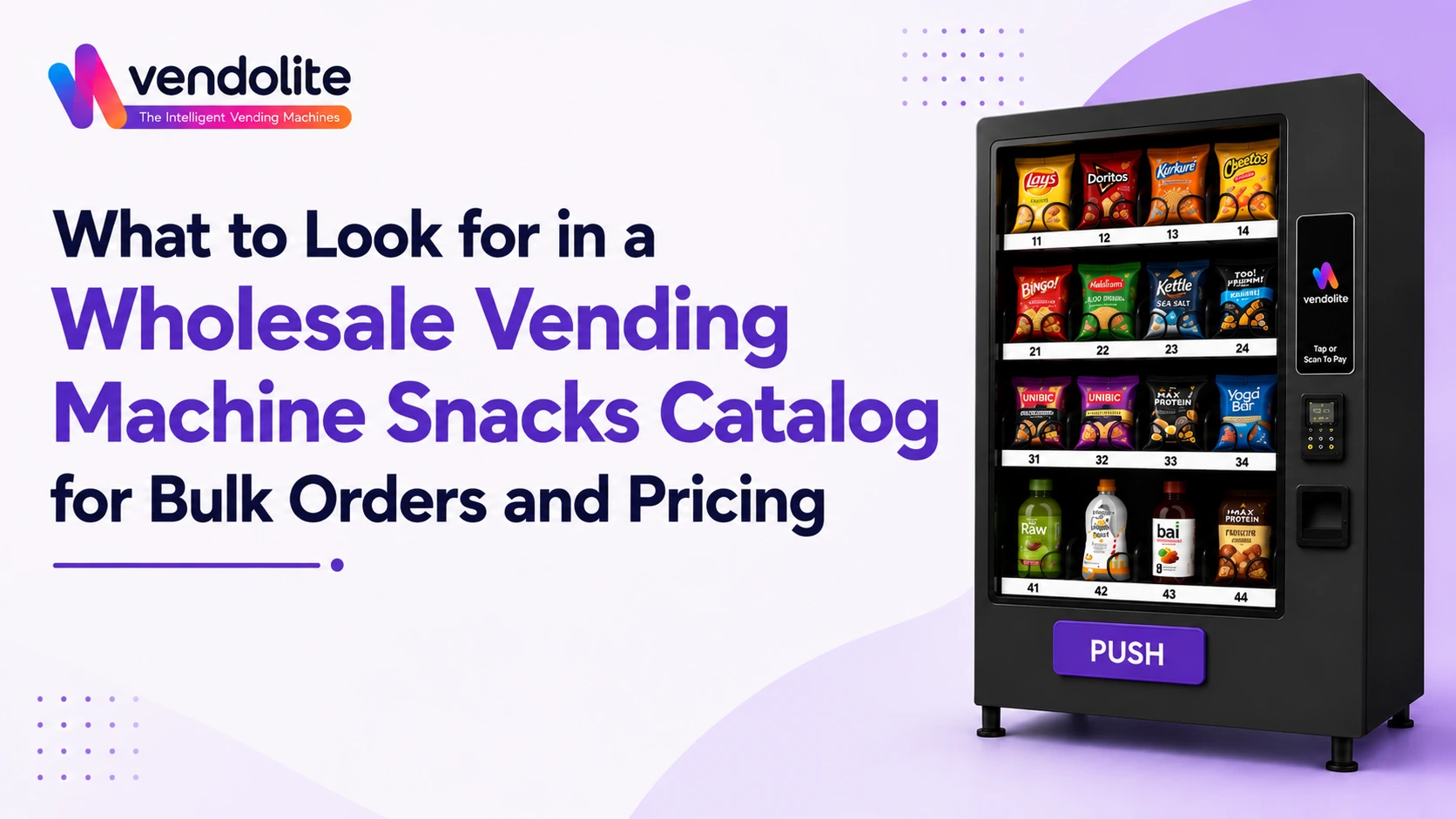
A field guide for vending operators in India, based on how routes are sourced and run in 2026.
When you open a supplier’s catalogue, you are really trying to answer a single question: can you stock these products, sell them through a machine, and still keep a margin once every cost is counted? Choosing vending machine snacks for an automated retail point is a different exercise from picking stock for a kirana shelf — the product has to fit the machine, sell on impulse, and survive weeks inside a metal cabinet that may sit in a humid lobby. This guide walks through what experienced operators actually inspect before they commit to a large order.
A grocery wholesaler sells to a shopkeeper who restocks daily. A vending operator restocks a fixed-capacity machine once or twice a week and earns on a per-pack, impulse purchase. That single difference changes everything downstream. A typical snack spiral holds one column of identical packs, so pack thickness, bag width, and weight all have to match the machine’s coil pitch and drop zone. An oversized family pack that looks like a bargain in the catalogue will jam a spiral or never fit the tray. The best vending machine snacks are single-serve — roughly 25 g to 60 g — priced at a round, tappable amount, and recognisable enough that a customer buys without thinking. Keep that filter in mind through every section below.
The shortest route to dead stock is buying variety for its own sake. Anchor the order around fast-moving staple vending machine snacks, then add niche items only after the basics prove themselves.
Most profitable Indian vending columns lean on a familiar core: namkeen and mixtures such as sev, bhujia, and chivda; potato chips and extruded snacks; biscuits and cream-filled cookies; chocolate and wafer bars; and, increasingly, roasted makhana, nuts, and baked options for the health-conscious office crowd. Regional favourites like murukku or banana chips can quietly outsell national brands in the right spot.
A machine in a college hostel sells very different vending machine snacks from one in a corporate IT park or a hospital waiting area. Students chase value and bold flavours; office staff will often pay a little more for branded or better-for-you options. Read the catalogue against your real location, not against what happens to be trending nationally.
This is where a genuine wholesale list separates itself from a retail price sheet dressed up as one. If the rates are not clearly volume-based, you are not looking at true wholesale.
Look for tiered slabs, where the per-pack rate at ten cartons clearly beats the rate at one, and a stated minimum order quantity per SKU. Many suppliers set MOQs by the carton or by weight, so confirm you can actually move that quantity before the date code runs out.
If a pack lands at ₹9 each for a single carton but ₹7 each at twenty cartons, the ₹2 saving only helps if a machine clears those twenty cartons inside the product’s freshness window. Volume discounts are real savings only when they meet real turnover.
The quoted figure is rarely the landed cost. GST, inbound freight, and any packaging or handling charge all sit on top, and together they decide whether your profit margins survive. Ask the supplier for a landed cost per pack — inclusive of tax and delivery to your warehouse — so you are comparing like with like across vendors.
Before you fall for a discount, do the arithmetic line by line: landed cost per pack, the price the machine will charge, and the realistic margin once you subtract spoilage, restocking effort, and the occasional refund. A common working target in snack retail is a gross margin of roughly 20–40%, and vending often supports the higher end because the machine itself is the convenience the customer is paying for. The pricing of your vending machine snacks has to clear that bar on the slow sellers, not only on the hero products.
Snacks are fast-moving FMCG, and a deep discount usually signals stock that is closer to expiry. Check the manufacturing date for freshness and confirm a sensible shelf life — six to twelve months is typical for many packaged Indian snacks. However, fried namkeen tends to be shorter. Then match the order size to how fast a single machine actually turns that item; buying a quarter’s supply of a slow mover all but guarantees write-offs.
Packaging is underrated, and it is the difference between a smooth route and constant jams.
Confirm consistent pack sizes and that bag or box dimensions are documented, because a machine planogram is built around them. Pillow-pack bags need enough rigidity to fall cleanly; flimsy film snags on a spiral and triggers refunds.
In humid markets such as coastal Kerala or Chennai, seal integrity is what keeps chips from going soft inside the cabinet. Every pack should carry a printed MRP, a barcode for your inventory system, and clear batch and date marking. Catalogue vending machine snacks that ship retail-ready, individually sealed, and barcoded will save you hours of relabelling and reconciliation.
A cheaper rate from an unreliable source costs more the moment a shipment is late, and your machines stand empty. Treat supplier diligence as seriously as pricing.
Insist on a valid FSSAI licence — the legal baseline for selling packaged food in India, regulated by the Food Safety and Standards Authority of India — and on proper GST invoices so you can claim input tax credit. No paperwork, no deal.
Ask about batch-to-batch consistency, which matters most for namkeen, makhana, and roasted lines where oil, spice, and grading drift between lots. Confirm lead times you can plan routes around, and get a written replacement policy for stock that arrives crushed or leaking. Dependable supply is what keeps vending machine snacks flowing through every machine without gaps.
Pin down who pays for transport, whether delivery is built into the quoted price, and who bears the loss if cartons are damaged in transit. For heat- and humidity-sensitive items like chocolate, ask how the supplier handles storage and last-mile delivery through summer — melted bars are unsellable and rarely refundable unless the terms say so in writing.
Once your routes are steady, branding is how an operator moves beyond reselling someone else’s labels. Ask whether the supplier offers private-label or custom sachet packing, logo printing, and whether any territory exclusivity is available. Owning the pack is what turns a route into a defensible vending machine business rather than a thin reselling operation with no pricing power.
Even an excellent rate is worthless if the SKU sits unsold. Before committing to large bulk snack orders, check what nearby kirana stores and supermarkets charge for the same pack, watch which items empty fastest from your existing machines, and plan for seasonal spikes around festivals, exams, and the start of school terms. Let live sales data, not a glossy catalogue photo, decide the final order.
When you are scanning a catalogue of vending machine snacks at speed, it earns a closer look only if it offers clear slab pricing, a workable MOQ, FSSAI and GST compliance, a comfortable freshness window, machine-friendly single-serve packaging, dependable supply, proven fast-movers, and real margin headroom on the slow sellers. Miss several of these, and the “deal” is usually a trap dressed as a discount.
Sourcing well is only half the job; the other half is running machines that reliably sell. If you would rather skip the trial and error, Vendolite is worth a serious look. As India’s first vending machine company — operating since 2013 with more than 6,000 machines installed worldwide — Vendolite pairs IoT-enabled hardware (real-time stock tracking, automated refill alerts, and UPI, card, and RFID payments) with retail, rental, franchise, and in-house refilling support. That means the right vending machine snacks reach the right location with far less guesswork, and you get a single dashboard to watch sales, stock, and machine health across your whole network. For a new operator, that combination of machines, software, and supply support is the shortest path from your first installation to your first profit.
Buy vending machine snacks wholesale from FMCG distributors, cash-and-carry chains like Metro, brand-authorized distributors, or B2B platforms like Udaan for volume pricing. Verify pack dimensions fit machine spirals, check shelf life and prioritize proven fast-movers. Vendolite's catalog guide details what operators inspect before bulk orders.
The machine can hold pens, notebooks, markers, geometry sets, and other daily essentials.
Yes, educational spaces are the most common installations, ensuring students never miss essentials.
Customers can pay using cash, cards, UPI, or mobile wallets.
With IoT-enabled monitoring, restocking is efficient and based on real-time usage.
Talk to our experts!