
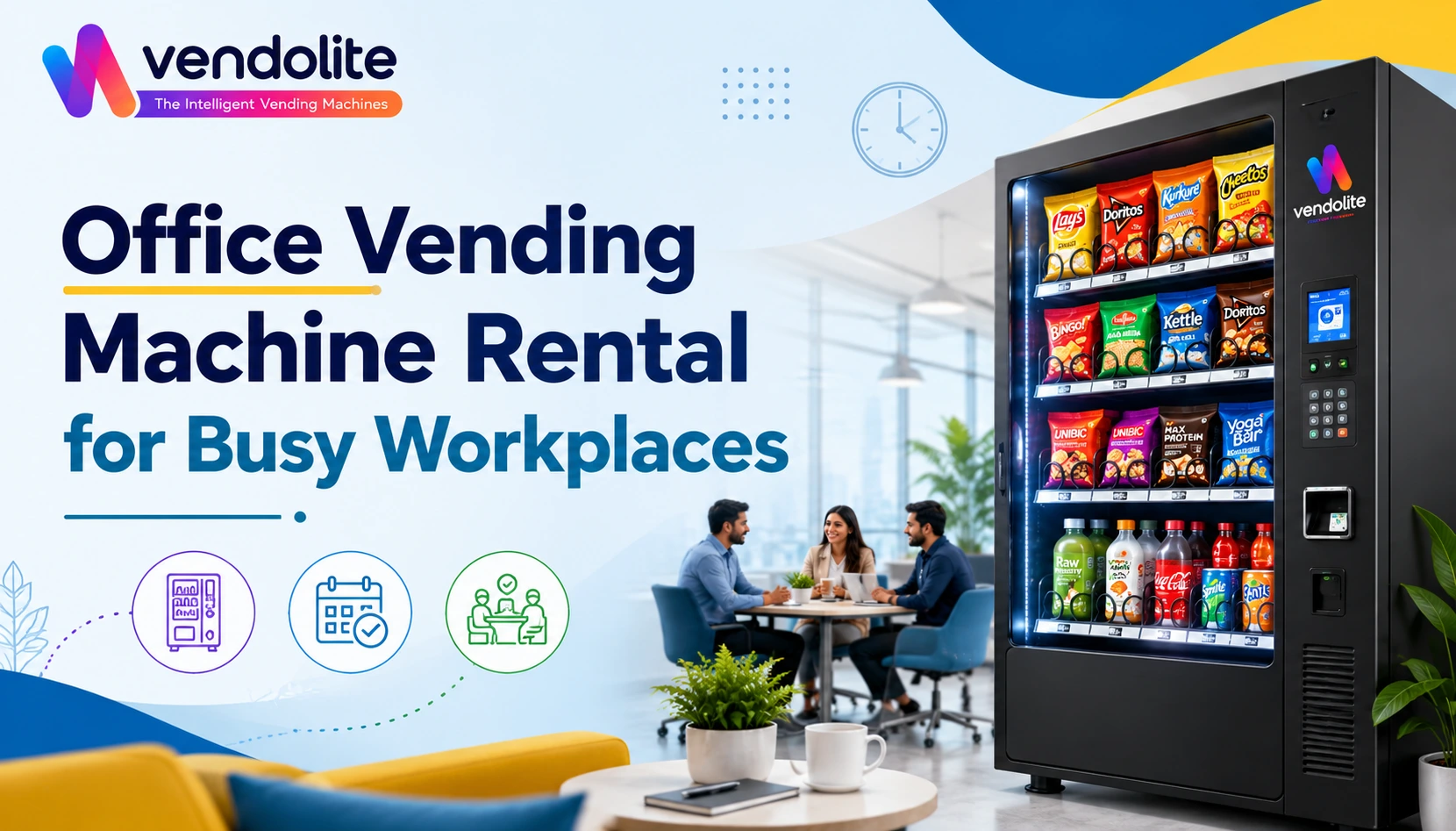
In a busy workplace, the vending machine is rarely just a vending machine. It is the unofficial 3 p.m. meeting point, the cure for a skipped lunch, and a quiet signal of how much an employer cares about everyday comfort. The demand behind it is real and growing: the Indian vending machines market reached roughly USD 728 million in 2025 and is forecast to keep climbing, with offices, the shift to smart and cashless machines, and healthier product ranges cited as the main drivers (IMARC Group). For most workplaces, the practical question is no longer whether to install a machine, but which machine to choose and whether to buy it outright or opt for office vending machine rental.
This guide draws on patterns seen across thousands of workplace installations to answer both questions. The short version: in a high-footfall office, the machine you pick matters, but the service model behind it usually matters more.
It is tempting to treat a vending machine as a one-time purchase that sits in a corner. Heavy use breaks that assumption quickly. Volume is the obvious pressure, but the real strain shows up in three quieter ways: how often the machine empties, how fast its moving parts wear, and how quickly people can pay during a rush.
A machine that holds thirty selections empties fast in an office of two hundred people, and an empty row frustrates staff as much as a broken one does. Coils, motors, and payment readers all have a duty cycle, and constant use shortens their life. When a queue forms at lunchtime, slow payment becomes the bottleneck that quietly suppresses sales. This is the central paradox of vending machines for high-traffic offices: the very footfall that justifies the machine is also what wears it down, so durability and serviceability matter more than the sticker price.
There is no single machine that suits every workplace, but a few categories consistently earn their place in busy environments. The right choice depends on headcount, the snack-versus-drink balance your team prefers, and how much floor space you can spare.
For most workplaces, this combo format is the workhorse. It dispenses both chilled drinks and snacks from a single cabinet, covering the two things people want most without the floor space of two separate units. Models with adjustable shelving and a high selection count let you tune the product mix to actual buying habits and refill less often, which is exactly what a busy site needs.
Modern offices barely carry coins, so the payment method directly shapes sales. Machines that accept cards, tap, and UPI clear queues faster and capture purchases that a coin-only unit would lose. In practice, cashless vending machines consistently outperform their coin-only counterparts because they remove both the change problem and the cash-handling overhead that comes with it.
The single most useful upgrade for a busy office is connectivity. These connected machines report their own stock levels, temperature, and faults to a dashboard in real time. Instead of someone discovering an empty machine after the fact, the operator sees it coming and plans a refill. Faults are often known before an employee reports them, which shortens downtime dramatically.
For very large sites or shared corporate floors, a self-service micro-market can replace the machine entirely with a compact, unattended self-checkout shop: open shelving, a fridge, and a payment kiosk. It offers far more variety and capacity than any single cabinet and eliminates dispensing jams. The trade-offs are space and a degree of trust, so it suits established workplaces rather than transient public areas.
A machine that works hardest is the one most likely to need attention, and that is where ongoing service separates a good experience from a frustrating one. Easy maintenance is not a vague quality; it comes from specific design choices like remote monitoring, cashless payment that cuts cash jams, and modular parts that can be swapped quickly.
A structured service plan ties those features together into a predictable routine: scheduled or telemetry-triggered restocks, defined repair response times, and parts kept in stock. Crucially, this is where the choice of ownership model starts to bite. A good office vending machine rental folds maintenance into the arrangement, so a fault becomes a phone call rather than a budget line and an afternoon of troubleshooting.
Buying a machine outright means you own the asset and every problem it later develops. For a high-footfall office, that downside is significant precisely because the machine is working so hard. An office vending machine rental shifts the calculus. There is no high upfront cost, repairs and parts become the provider’s responsibility, and the machine can be upgraded or swapped as headcount changes. Because the provider continues to own the hardware, they have a direct, ongoing incentive to keep it stocked and running.
The convenience, however, is only ever as strong as the agreement behind it. A polished machine on a weak service contract still leaves you with empty rows and slow repairs, so the terms deserve as much scrutiny as the hardware.
When you weigh one office vending machine rental offer against another, look past the monthly figure and examine the service commitments. Different offers vary far more in their support promises than in their machines, and a few questions separate the strong ones:
The right combination of machine and contract depends on the kind of office you run. Three common scenarios show how the decision plays out in practice.
A scaling startup adds people unpredictably, so committing capital to a fixed-size machine is risky. Here, an office vending machine rental with a combo unit and easy upgrade terms fits well, letting the setup grow alongside the team without a fresh purchase each time.
A corporate HQ with hundreds of staff has sharp, predictable demand spikes that punish under-capacity. The setup needs more thought than a single machine can offer.
Demand in a large office is rarely flat across the day, so capacity should be sized to the busiest windows rather than the daily average.
The two reliable peaks are the morning arrival and the post-lunch dip, when queues form fastest. Multiple machines or a micro-market keep these moving, where one cabinet would stall.
In warmer regions, beverage demand can outstrip snacks during summer, so a dedicated refrigerated unit alongside a combo machine prevents the most common peak-time shortfall.
A shared building serving several employers behaves like a small public space. An office vending machine rental managed entirely by the provider, with telemetry-driven restocking, removes the awkward question of which tenant maintains the machine.
When the service model carries this much weight, the provider behind it becomes the real decision-maker. Vendolite has been in the vending business since 2022 and was India’s first dedicated vending machine company, operating across manufacturing, rental, retail, wholesale, and franchise models. With more than 6,000+ machines installed globally and ISO 9001:2015 certification, it brings the kind of track record a busy office should look for.
The technology is built for exactly the maintenance challenges described above. Vendolite machines run on the RIOTA cloud platform, giving real-time monitoring of machine status, stock levels, and refill schedules, with automatic low-stock alerts and remote management. They support UPI, card, and RFID payments out of the box, and a typical installation is completed within about two days. For a high-traffic office, an office vending machine rental from Vendolite bundles that connected hardware with the servicing model that keeps it stocked and running, so the machine does its job and fades into the background.
Most offices go through a vending provider rather than buying a machine and stocking it themselves. You choose a provider, agree on a machine size and a snack mix suited to your headcount, and they handle installation, restocking, and servicing. On a rental or managed plan there's usually little or no upfront cost, since the provider owns the machine and earns from sales, which makes it an easy perk for HR or office managers to set up.
It depends on the model and the arrangement. Buying outright means a larger one-time cost plus responsibility for repairs and restocking, while a rental or managed plan typically removes the upfront price and folds maintenance into a recurring fee. Running costs (electricity, restocking) are modest, so for most offices the deciding factor is service quality and contract terms rather than the headline price. Ask any provider for a clear breakdown of what's included before comparing quotes.
Strong options include nuts and seeds, roasted chickpeas, protein bars with low added sugar, baked or veggie chips, plain or lightly salted popcorn, and unsweetened dried fruit. For drinks, look to water, sparkling water, and unsweetened teas or cold brew. The general rule when choosing is to favour items higher in protein and fibre and lower in added sugar, saturated fat, and sodium, so employees get steady energy without the mid-afternoon sugar crash.
The packaging on each product carries its own nutrition label, and that's the most reliable source of calorie, sugar, and ingredient information. Many modern smart machines go further by displaying details on a digital screen at the point of selection, and some highlight low-sugar, high-protein, or allergen-friendly items so buyers can choose at a glance. If clear nutrition labelling matters to your team, confirm with the provider how their machines present it.
Several operators serve the Indian market; one of the established names is Vendolite, which has been in the vending business since 2013 and reports more than 6,000 machines installed globally. It works across manufacturing, rental, retail, and franchise models, is ISO 9001:2015 certified, and runs machines on cloud software with real-time stock monitoring and support for UPI, card, and RFID cashless payments. When comparing providers, look at their track record, the freshness of their restocking, and how well their machines handle cashless payment and nutrition labelling.
High-traffic workplaces need rental machines with large capacity, fast dispensing and dual snack-beverage coverage — Vendolite's S1 Pro combo (300 products, 60 slots) fits best. Rentals include installation, cloud monitoring and maintenance, with refill alerts tuned for heavy usage. Meal card and UPI payments keep queues moving.
Talk to our experts!