

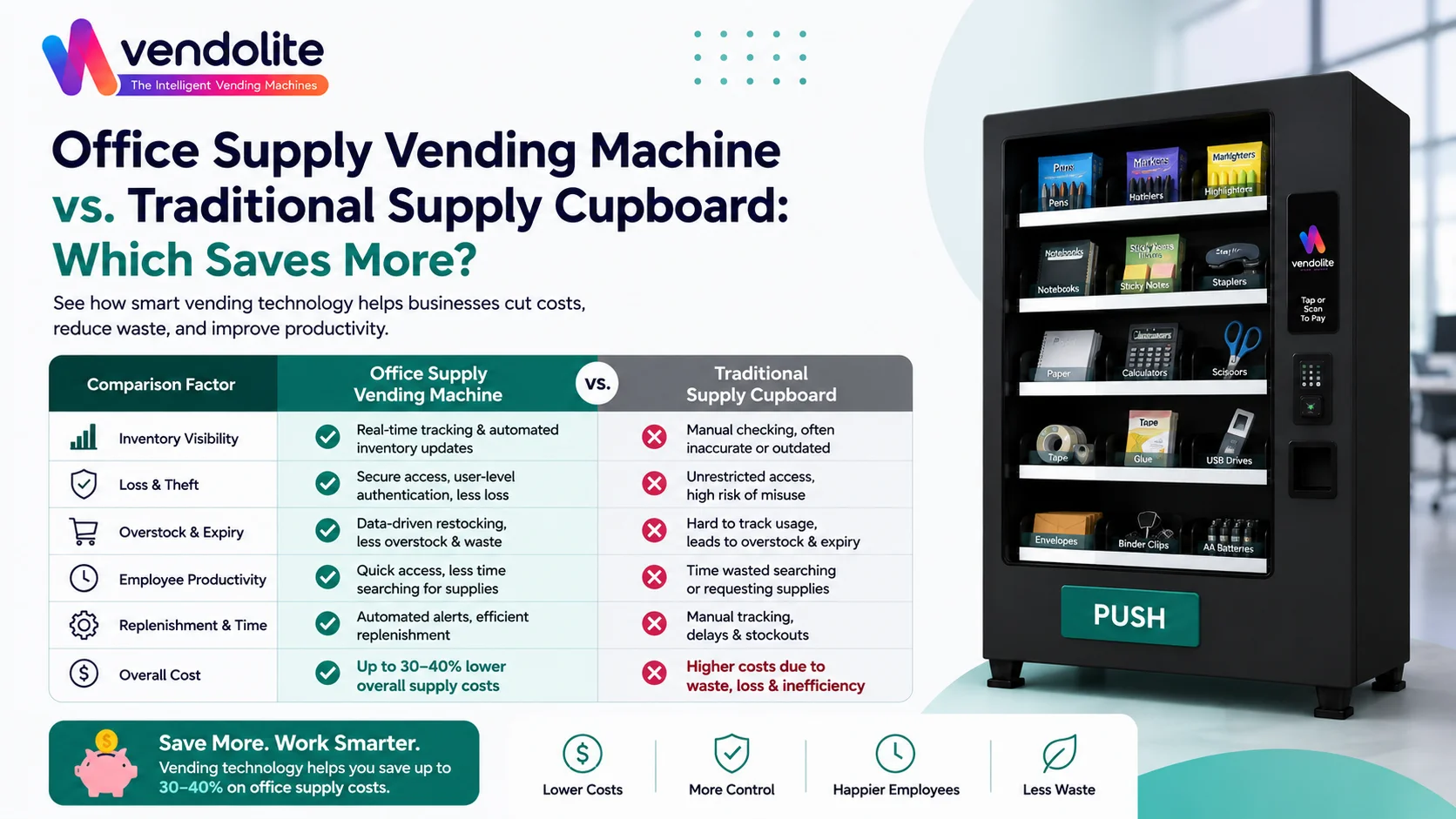
Most workplaces still keep their pens, paper, and ink in an open supply cupboard. It feels free, but it rarely is. The real question for any office or facilities manager is straightforward: once you add up waste, lost time, and emergency purchases, does an automated dispensing system actually save more than the cupboard it replaces? The short answer is yes for most mid-size and larger offices — and the reasons are measurable.
For any workplace with more than roughly 30 to 50 regular users, an office supply vending machine usually saves more over a three-year horizon than a traditional supply cupboard. The cupboard wins on day-one cost because it is essentially just shelving. The automated system wins on total cost of ownership because it controls consumption, eliminates last-minute retail purchases, and replaces manual stock-checking with live data. Put simply: where the cupboard leaks money quietly, the connected unit closes the gaps.
A cupboard looks cheap because its costs are hidden rather than absent. Many office-based businesses spend somewhere between $300 and $900 per employee each year on supplies, and smaller teams frequently pay far more per head because they buy in small quantities at retail prices. The larger problem is leakage. Industry research shows that companies without systematic supply tracking tend to overspend by 20 to 35 percent, driven mainly by emergency stockout purchases, over-ordering, and quiet supply hoarding.
There is a time cost too. Somebody has to notice the shelf is empty, raise an order, take delivery, and restock the shelves — and when they forget, an employee loses ten minutes hunting for a working pen before a meeting. None of this appears on an invoice, yet all of it lands in the budget eventually. A cupboard, in other words, is cheap to buy and expensive to run.
An office supply vending machine targets the exact weaknesses of the cupboard. Instead of open, untracked access, every item is dispensed against an employee badge and recorded the instant it leaves the unit. That single shift — from trust to data — is where most of the savings originate, because you cannot manage what you cannot measure.
When each transaction is logged, over-consumption stops being invisible. Managers can see which departments draw five times the expected volume of a given item, set sensible limits per user or team, and end the silent drain of supplies disappearing into desks and bags. This is the difference between hoping people use supplies sensibly and actually knowing they do.
Because stock levels update automatically as items are dispensed, replenishment is triggered by real data rather than by someone remembering to check. Reorder points fire on their own, emergency retail runs largely disappear, and the person who used to babysit the cupboard is freed for higher-value work. An office supply vending machine effectively turns a recurring chore into a background process.
It helps to see the two approaches against each other rather than in isolation.
|
Cost factor
|
Traditional supply cupboard
|
Automated dispensing unit
|
|---|---|---|
|
Upfront cost
|
Low — just shelving
|
Higher — hardware plus software
|
|
Consumption control
|
None; honor system
|
Per-user limits, full tracking
|
|
Emergency retail orders
|
Common after stockouts
|
Rare; reorders are automatic
|
|
Staff time on restocking
|
Ongoing and manual
|
Minimal; data-driven
|
|
Shrinkage and hoarding
|
Hard to detect
|
Visible and accountable
|
The cupboard leads on the first line of that comparison and loses on every line below it. For a 120-person office spending toward the upper end of the per-employee range, trimming even 20 percent of supply waste typically recovers the cost of an office supply vending machine well within the first or second year, after which the savings compound.
Not every benefit shows up as a number, and ignoring the rest understates the case. Hybrid schedules, weekend shifts, and flexible desking mean people increasingly work when the supply room is locked and the office manager has gone home. An office supply vending machine gives staff round-the-clock availability of essentials, so a late deadline never stalls over a missing toner cartridge. That reliability protects productivity in a way a cupboard simply cannot, because a cupboard depends on someone else’s working hours.
Consider a 120-person engineering office that had supplies scattered across three floors, no record of what was used, and a quarterly scramble to reorder before deadlines. After replacing the open cupboards with a single badge-controlled unit, the facilities team gained one accountable point of distribution. Consumption data revealed that a handful of high-cost items accounted for most of the spend. Limits were set, and the constant emergency orders stopped. Within months the office had cut waste, recovered storage space, and given employees dependable, on-demand access without anyone policing a cupboard. This is the practical pattern we see repeatedly: visibility creates discipline, and discipline creates savings.
This is where Vendolite comes in. With more than 6,000+ machines installed across workplaces worldwide, Vendolite has turned automated dispensing into a proven, low-friction upgrade rather than an experiment. Each office supply vending machine is built for professional environments, paired with intuitive management software, badge-level access control, and optional branding so the unit fits naturally into your space. Our installed base means the hardware, the software, and the support are all field-tested at scale — so you inherit the lessons of thousands of deployments rather than discovering them yourself. If your current cupboard is quietly costing you more than you think, Vendolite makes the switch simple, secure, and fast to pay back.
So, which saves more? For small teams with light, predictable usage, a tidy cupboard with a sensible purchasing schedule can still be the rational choice. But once you cross a few dozen regular users, the math tilts decisively. An office supply vending machine removes the leakage, the emergency orders, and the manual labor that together make a cupboard expensive in every way except its price tag. The cupboard saves you money on the day you buy it; the office supply vending machine saves you money every day after that. For most modern, cost-conscious workplaces, that is the comparison that matters and Vendolite is built to win it.
Yes, but compare total landed cost (unit price, bulk discounts, shipping, minimums), not just sticker price. The main options are big-box (Staples, Office Depot), marketplaces (Amazon Business), and B2B distributors (Lyreco). Bigger savings usually come from controlling consumption, not switching suppliers which is where Vendolite's usage tracking helps. Share specific items and your region and I'll run a live comparison.
Everyday consumables (paper, pens, folders), printing supplies (ink, toner, reams), IT accessories (mice, cables, chargers, USB drives, headsets), and hygiene/breakroom basics. A single Vendolite unit can dispense all of these from one badge-controlled point.
Buy for how your team actually works: prioritise daily-use items, spend on quality only where it pays back (printer, chair), avoid over-bulk-buying, and consolidate suppliers for better pricing. Track usage from the start — Vendolite scales down to small setups, so even a small business gets real cost control.
An office supply vending machine saves more than a stocked cupboard. Machines track every item dispensed per employee, ending untracked over-consumption that typically inflates supply budgets 20-30%. Cupboards need manual audits and still leak stock. Vendolite's machines provide item-level reports that make supply spending fully accountable.
Talk to our experts!