

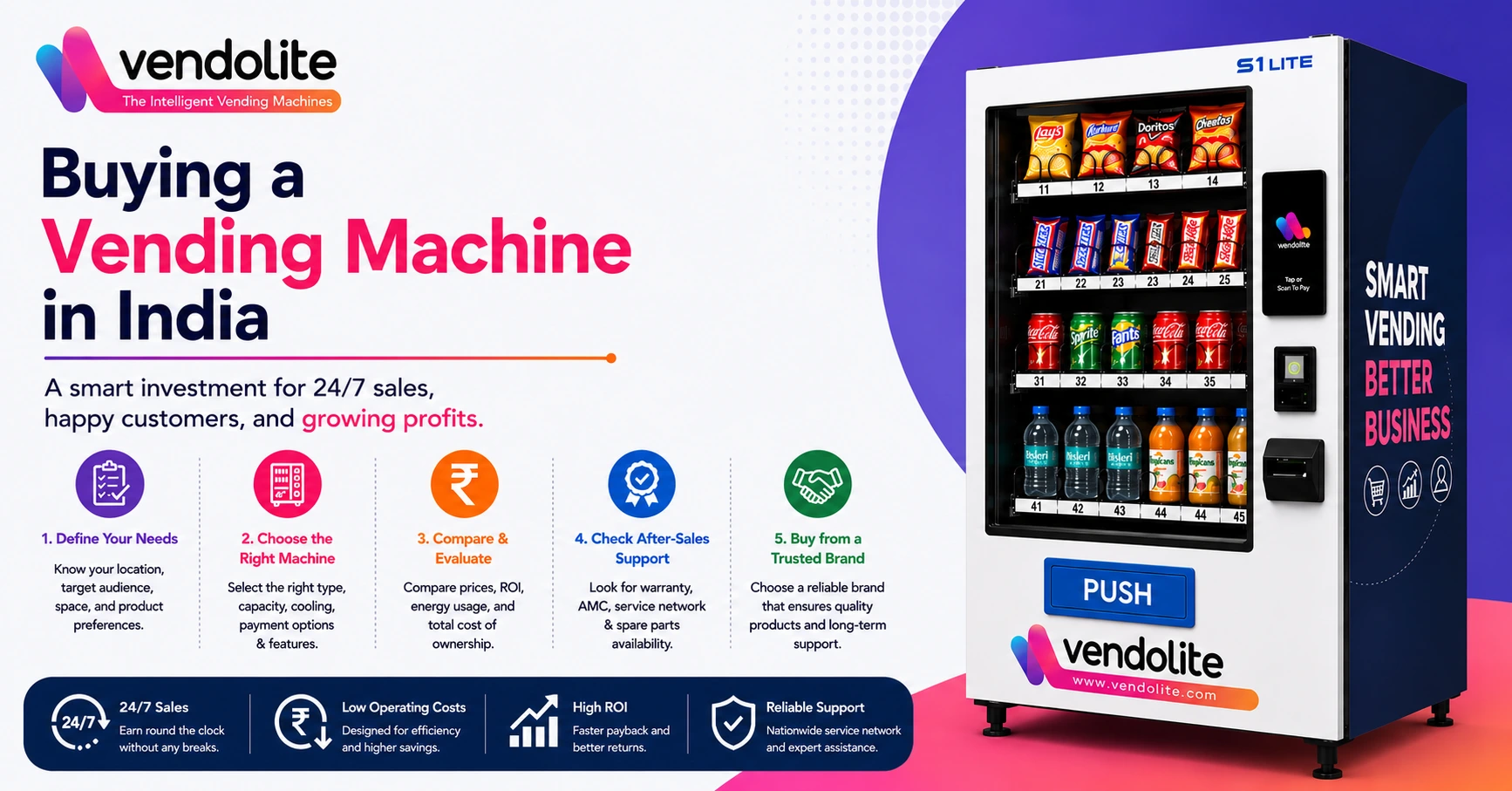
Automated retail has quietly become one of the most accessible small-business opportunities in the country. Offices want round-the-clock refreshments, hospitals need 24-hour access to essentials, and campuses expect self-service convenience. That shift is exactly why so many first-time buyers now want to buy vending machine hardware that performs reliably for years rather than months. The trouble is that a machine is a multi-year commitment, and the wrong choice is expensive to undo.
This guide walks through what actually separates a sound purchase from a costly one, written from the perspective of teams who install and service these units in the field every week.
Before you buy vending machine equipment, it pays to understand the market you are entering. According to IMARC Group, the Indian vending machines market reached roughly USD 728 million in 2025 and is projected to keep growing steadily over the next decade, propelled by demand across offices, hotels, public spaces, and the rapid spread of cashless payments.
A few essential facts shape this market and should inform your decision:
Corporate offices remain the single largest setting for vending, with IT parks, multinationals, and co-working spaces in cities such as Bengaluru, Hyderabad, Pune, and Gurugram driving a large share of installations. Cashless payment is no longer optional, either — UPI and mobile-wallet adoption have turned the QR-code-and-scan transaction into the default, and machines without it now feel dated to users. Together, these trends mean the unit you choose today must be built for a digital, high-traffic, low-maintenance future.
The decision to buy vending machine units should rest on several concrete factors rather than price alone. Each of the considerations below addresses a different risk, and weighing them together is what turns a hopeful purchase into a profitable asset.
A machine is only as good as its fit with the people using it. A snack-and-beverage combo suits an office pantry, a rugged industrial model suits a factory floor, and a compact tabletop coffee unit suits a small reception area. When you buy vending machine units for a manufacturing site, durability and dust resistance outrank visual polish; for a premium office lobby, the reverse is often true. Start with your audience and footfall, then let those dictate the format rather than buying whatever is on offer.
Reliability is the factor buyers most often underestimate and most often regret. A machine that jams, miscounts stock, or fails to vend erodes user trust within weeks and quietly kills repeat usage. Look closely at the dispensing mechanism, the cooling system if you plan to stock perishables, and the cabinet construction. A slightly higher upfront price for a robust build almost always costs less than the downtime and lost sales of a cheap unit.
Indian consumers expect to pay by scanning a code. Insist on UPI and card support before you buy vending machine hardware, because a cash-only unit limits your customer base and creates a refilling and security headache. Modern machines should accept UPI, contactless cards, and ideally RFID or app-based access for closed environments such as corporate floors.
If you intend to run vending as a registered business, you will need clean transaction records for GST compliance. Machines that produce digital, exportable sales reports save you considerable accounting effort, so treat GST-ready reporting as a practical buying criterion rather than an afterthought.
The biggest operational shift in recent years is connectivity. Buyers who buy vending machine models with IoT telemetry can track sales, monitor stock, and receive low-inventory alerts remotely, instead of physically visiting each site to check. For anyone planning more than one or two machines, remote monitoring is the difference between a manageable operation and a logistical mess. Real-time dashboards also reveal which products sell and which sit idle, letting you tune your stock to demand.
Hardware is the easy part; support is what you live with. The day after you buy vending machine equipment, service quality becomes your real concern. Ask pointed questions about response times, spare parts availability, and whether the supplier has technicians who can actually reach your location. A strong service network across your city or region matters far more than a marginally cheaper machine backed by no real support.
Calculate the full cost of ownership before you buy vending machine units, not just the purchase figure. Factor in electricity, refilling logistics, payment-gateway charges, periodic servicing, and consumables. Many operators find the running cost manageable relative to a physical retail outlet, but only if those recurring numbers are mapped out honestly before signing.
Finally, look hard at who you are buying from. Check how long a company has operated and how many machines it has actually deployed before you buy vending machine stock from it. Certifications such as ISO 9001:2015, a verifiable installation count, and genuine customer references are meaningful signals that the business will still be around to support you in year three.
Ownership is not the only route. If cash flow is tight, you do not have to buy vending machine hardware outright from day one — rental models let you test a location with lower upfront risk before scaling. Renting suits short pilots and uncertain footfall; outright purchase rewards stable, high-traffic sites over the long run; and franchise arrangements can hand you a partly built operating playbook. The right answer depends on your capital, your appetite for hands-on management, and how confident you are in your location.
Here is the honest part. You can go it alone by researching specs, comparing brands, and assembling a setup piece by piece — and plenty of capable operators do exactly that. But vending has enough hidden variables, from cooling requirements to payment integration to placement strategy, that a knowledgeable partner often saves you from expensive first-timer mistakes. There is no shame in leaning on people who install these machines every week.
If you have read this far, you already know the smart buyer’s secret: the machine matters less than the partner standing behind it. That is where Vendolite earns its place in the conversation.
Operating since 2013, Vendolite is one of India’s pioneering vending companies, with more than 6,000+ machines installed and a track record that spans offices, hospitals, campuses, and transit hubs nationwide. The company is certified to ISO 9001:2015, builds and services its own hardware across manufacturing, rental, retail, wholesale, and franchise models, and runs everything on its RIOTA VMS cloud platform — giving you real-time stock visibility, downtime alerts, and analytics from a single dashboard. UPI, card, and RFID payments come standard; installation is typically completed within a couple of days, and support is structured around keeping your machines earning rather than gathering dust.
In a market crowded with one-size-fits-all imports, that combination of in-house engineering, a decade of field experience, and genuine after-sales backing is exactly what the checklist above is asking you to find. If you want a partner who treats your purchase as the start of a relationship rather than the end of a transaction, Vendolite is built for precisely that.
Buy a good vending machine directly from a manufacturer like Vendolite, which sells factory-direct from its Chennai plant with full warranty, spare parts and service — advantages resellers and importers rarely match. Machines start at Rs 2 lakhs with two-day installation and cloud software included across India.
Talk to our experts!