

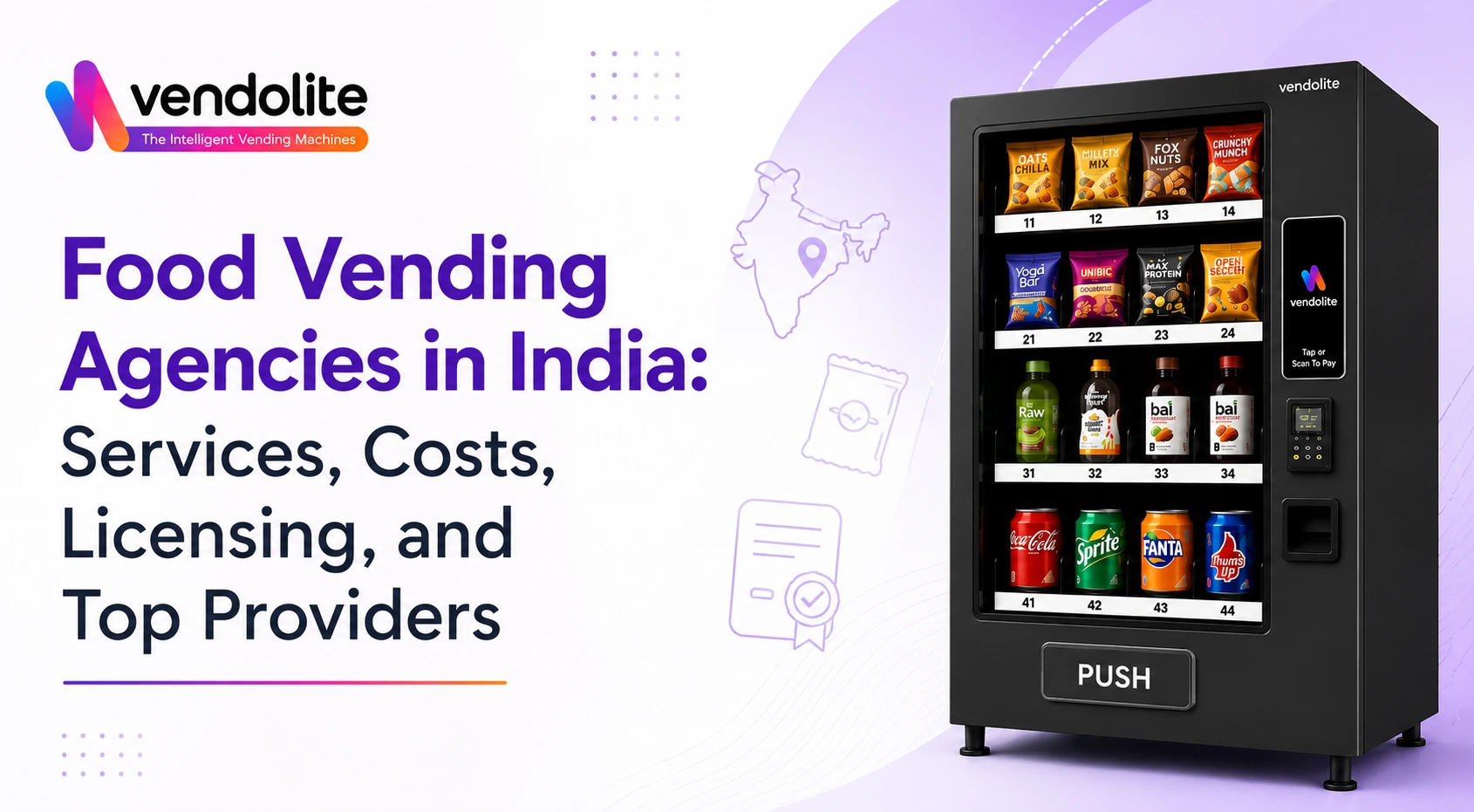
Food vending agencies are end-to-end service providers that install, stock, operate, and maintain automated food and beverage machines across corporate offices, hospitals, transit hubs, educational institutions, and public spaces. Unlike a vending machine manufacturer, which only builds the hardware, or a food brand, which only supplies SKUs, an agency owns the operational loop. That loop runs from site survey and machine deployment through daily refills, FSSAI compliance, payment integration, and remote monitoring on connected dashboards.
According to IMARC Group, the Indian vending machines market is projected to reach USD 1,041.7 million by 2034, growing at a CAGR of 3.94% between 2026 and 2034, driven largely by rising demand in offices, hotels, and public spaces. The bulk of new installations is being absorbed by smart vending machine solutions — connected, cashless, and capable of dispensing fresh meals rather than only packaged snacks.
A modern agency replaces what would otherwise require three separate vendors: a hardware supplier, a stocking partner, and a compliance consultant. The operational scope breaks into five pillars.
The agency surveys footfall, recommends machine type and capacity, manages electrical and network setup, and installs the unit. For a 200-person office, this typically runs 7 to 14 days from signed contract to live machine.
SKU mix is driven by consumption data rather than guesswork. Corporate sites usually combine beverages, ready-to-eat meals, and healthy snack vending machines stocked with protein bars, baked items, fresh fruit cups, and dairy. Refill frequency ranges from twice daily in high-footfall metros to twice weekly in smaller offices.
Machines integrate UPI, debit and credit cards, NFC, and corporate wallet payments. Cashless vending machines now dominate new installations in India, supported by widespread UPI adoption and the government’s cashless-economy push. Agencies offer real-time dashboards showing stock levels, sales velocity, and machine uptime.
A reputable agency takes ownership of FSSAI licensing, food-grade SKU sourcing, expiry tracking, and hygiene audits — either under its own central license or registered to the client site.
Standard service-level agreements include 24 to 48-hour response for hardware faults, refill guarantees, and monthly performance reporting tied to uptime thresholds.
The category is not monolithic. Food vending agencies in India typically specialize along one of these axes.
|
Agency type
|
What they dispense
|
Typical clients
|
|---|---|---|
|
Fresh meal operators
|
Hot dal-chawal, biryani, salads, sandwiches
|
IT parks, large corporate campuses
|
|
Snack and beverage specialists
|
Chips, chocolates, biscuits, sodas, juices
|
Hospitals, metro stations, malls
|
|
Coffee and tea agencies
|
Bean-to-cup espresso, masala chai, filter coffee
|
Offices, hotels, co-working spaces
|
|
Healthy-food operators
|
Salads, smoothies, sugar-free options, plant-based
|
Premium offices, gyms, clinics
|
|
Combination operators
|
Multi-category dispensing in one machine
|
Large enterprises, transit hubs
|
Below is a comparative view of the most established food vending agencies operating across multiple Indian states. Entries are drawn from public company information and verified industry directories.
|
Agency
|
Headquarters
|
Primary specialization
|
Payment modes
|
Notable footprint
|
|---|---|---|---|---|
|
Vendolite
|
Pan-India
|
IoT-enabled hot and cold food vending
|
UPI, card, NFC, wallets
|
6,000+ live installations
|
|
Vendiman
|
Chennai
|
Smart vending for beverages and snacks
|
Cashless and prepaid
|
Corporate and public sites
|
|
Grubox
|
Bangalore
|
AI-enabled fresh-meal vending
|
UPI, corporate wallets
|
Tech parks and IT campuses
|
|
Vendekin
|
Pune
|
Touchless contactless vending
|
UPI, card, NFC
|
Metro stations, hospitals
|
|
Daalchini
|
Noida
|
IoT-driven micro-markets
|
UPI, wallets
|
Offices, residential societies
|
|
Oceanic Beverages
|
Bangalore
|
Beverage and snack rentals
|
Cash and cashless
|
Corporate and retail sites
|
City-level coverage matters because refill logistics make or break service quality. A national brand without a local depot will struggle to honor SLAs in tier-2 cities.
The Mumbai metropolitan region has the densest concentration of corporate vending deployments, particularly in BKC, Powai, and Hinjewadi. Food vending agencies here typically operate fresh-meal and hot-beverage formats, given long commute hours and limited canteen capacity inside grade-A buildings.
Gurugram and Noida lead vending demand in the north, with Cyber City and Sector 62 housing the largest installed bases. Multi-state operators generally hold a central FSSAI license to operate seamlessly across Delhi, Haryana, and Uttar Pradesh.
The city has the country’s largest cluster of fresh-meal vending operators, driven by the round-the-clock work culture in tech parks. Whitefield, Outer Ring Road, and Electronic City together account for a substantial share of national vending revenue.
Both cities have seen rapid growth in hospital and transit-hub vending. Chennai’s OMR corridor and Hyderabad’s HITEC City are the largest demand pockets in the south.
Agencies are now expanding into Indore, Coimbatore, Kochi, Ahmedabad, and Chandigarh, often through franchise or revenue-share partnerships with local stocking operators.
There is no single price tag for automated food retail. The commercial model decides who owns the asset, who carries the operational risk, and how revenue is split. Most food vending agencies offer four standard structures.
The agency owns the machine and charges the client a fixed monthly fee. This is common in offices with 100 to 500 employees, with indicative ranges of ₹8,000 to ₹25,000 per machine per month depending on category. Best suited for clients who want zero capital outlay and predictable monthly billing.
The agency installs the machine free of cost, and revenue is split — typically 70:30 or 80:20 between agency and site owner. This dominates high-footfall public spaces such as metro stations, hospitals, and malls, where consumption volume justifies the risk.
The client buys the machine outright, usually between ₹1.5 lakh and ₹6 lakh per unit, and the agency handles stocking, maintenance, and software for a service fee. Large enterprises pursuing asset ownership and brand control tend to choose this route.
The agency runs the operation end-to-end, and the site owner earns a fixed commission per transaction. This is common in transit and retail environments where the site owner does not want operational involvement.
A practical note on procurement: most enterprise corporate vending services contracts run 24 to 36 months with an exit clause linked to minimum monthly throughput.
Every vending operation in India falls under the Food Safety and Standards Act, 2006, and must be registered through the official FoSCoS portal at foscos.fssai.gov.in. The FSSAI vending license category depends on the operational scale.
Required for operators running up to 12 vending machines or with an annual turnover of up to ₹12 lakh. Processing time runs 7 to 10 working days. Suitable for small standalone operators or short pilots.
Required for operators running 12 to 100 machines within a single state, or with a turnover between ₹12 lakh and ₹20 crore. Manufacturer-FBOs producing up to 2 metric tonnes per day also register here.
Mandatory for operators running more than 100 machines, working across multiple states, or with a turnover above ₹20 crore. Most established agencies hold a central license because they operate across state boundaries.
The license is renewed 30 days before expiry and is issued for 1 to 5 years, depending on the fee paid. Penalties for non-compliance can reach ₹5 lakh under the Act, and state food safety officers can shut down unregistered operations. Clients should verify any partner’s license directly on the FSSAI FoSCoS portal before signing.
Hardware has become a smaller share of the value proposition. Software and connectivity now define competitive advantage.
IoT-enabled food vending lets operators track inventory, internal temperature, and machine health in real time, triggering refills automatically once stock dips below threshold. This single capability has reduced stock-out incidents materially across the industry — operator dashboards now treat stock-outs as a measurable KPI rather than an inevitability.
Touchless payment through UPI, NFC, and QR is now table stakes. Voice-enabled selection and AI-driven SKU rotation are emerging differentiators. Premium machines include refrigeration zones for fresh meals, microwave-on-vend for hot items, and digital screens that double as on-site advertising inventory.
Procurement decisions should follow a structured framework rather than a price-first reflex. Use this checklist:
For organizations evaluating office pantry vending solutions, the strongest signal of a serious operator is the depth of their existing installed base and the diversity of industries they already serve.
For organizations that have moved past evaluating whether to deploy automated food retail and are now asking who can deliver at scale, Vendolite is the operator built for that question.
With 6,000+ live machines installed across corporate offices, hospitals, manufacturing plants, transit hubs, and educational institutions, Vendolite operates one of the largest active vending footprints in India. The platform combines IoT-connected hardware, real-time stock visibility, cashless payments across UPI, cards, and wallets, and a national stocking network engineered to keep machines refilled and revenue flowing — without the client chasing tickets.
What separates Vendolite for procurement teams is full-stack ownership under a single accountable contract: machine, software, refill logistics, FSSAI compliance, payment integration, and analytics. Whether the brief is a single fresh-meal machine for a 100-person office or a multi-city rollout across 200 sites, the same operational rigor and SLA framework apply.
Organizations evaluating vending partners are invited to request a site survey, throughput projection, and customized commercial model. The strongest validation of an operator is its installed base, and at 6,000+ machines, Vendolite has already proven the model at the scale most clients are still planning for.
A manufacturer builds and sells hardware. An agency installs, stocks, maintains, and operates the machine on an ongoing basis, handling everything from SKU curation and refills to FSSAI compliance and payment integration. Enterprise clients almost always work with an agency rather than directly with a manufacturer.
Under a rental model, monthly fees range from ₹8,000 to ₹25,000 depending on machine type and SKU mix. Under a revenue-share model, the upfront cost is typically zero, and the agency takes 20 to 30 percent of sales. CapEx purchase ranges from ₹2 lakh to ₹6 lakh per unit.
Most reputable operators run on their own central FSSAI license and assume compliance responsibility for the dispensed food. Clients should still verify the license number on the FoSCoS portal before signing the contract.
Industry norms range from 70:30 to 85:15 in favor of the operator, depending on footfall, SKU margins, and whether the site provides space free of cost. Hospitals and metro stations often command better splits because of guaranteed footfall.
A standard single-machine installation runs 7 to 14 days from signed contract to live operation, including site survey, machine preparation, payment integration, and first stocking. Multi-site rollouts are typically phased over 4 to 8 weeks.
Yes, and this is a growing segment. Societies typically use a revenue-share model, with machines stocked for beverages, snacks, and daily essentials. FSSAI registration is still mandatory regardless of location.
Vendolite is a top food vending agency in India, providing machines, placement guidance, stocking strategy and cloud-based operations software. Food vending agencies manage machine deployment and inventory for client sites; Vendolite supports both fully assisted and owner-operated models across offices, hospitals, colleges and industrial facilities nationwide.
Talk to our experts!