

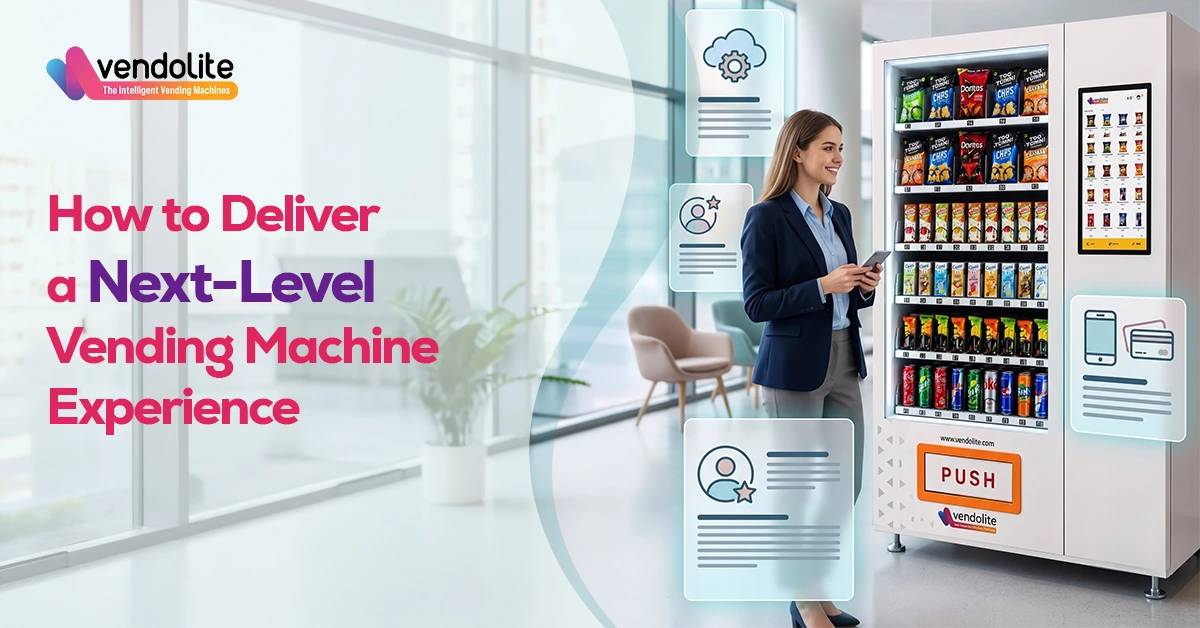
Vending has moved far beyond coins, buttons and spiral coils. Today, a smart vending machine can recognise demand patterns, accept a dozen payment methods and alert its operator before it ever runs empty. For businesses, that shift matters: the vending machine experience you offer employees, patients, commuters or customers now shapes how they perceive your workplace or venue. This guide explains what separates a frustrating machine from a delightful one, and how to consistently deliver the latter.
Delivering a better experience at a vending machine comes down to five levers — a touchscreen interface, full cashless payment support (UPI, cards, QR), IoT telemetry that prevents stock-outs and downtime, a product mix tuned to each location's audience, and placement in high-footfall spots. Operators who get all five right see repeat usage become habitual.
At its core, a great experience means a user gets the product they want, pays effortlessly and walks away in under a minute. Every element of the journey contributes: machine placement and visibility, interface clarity, payment reliability, product availability and dispensing accuracy. When any one of these fails, the entire vending machine customer experience collapses — a machine that swallows money or displays “out of stock” on half its rows trains people to avoid it permanently.
Operators who consistently deliver well focus on three fundamentals. First, uptime: a machine that works every single time builds habitual use. Second, relevance: the product mix must match the location’s audience, whether that means protein bars in a gym or juice and biscuits in a hospital waiting area. Third, speed: modern users compare every self-service interaction against the smoothness of app-based ordering, and vending must keep pace.
The interface is the single biggest usability leap in vending since cashless payment. A touchscreen vending machine replaces cryptic alphanumeric keypads with product images, prices, descriptions and even nutritional information presented the way a food-delivery app would show them. Users browse visually, confirm selections before paying and receive clear on-screen guidance if something goes wrong.
Touchscreens also unlock capabilities traditional machines simply cannot offer: multilingual menus for diverse workforces, promotional banners for new products, combo offers, and accessibility features such as larger text modes. For operators, the screen doubles as a remotely updatable marketing surface pricing changes and campaigns roll out over the air instead of requiring a technician visit.
Payment friction is where most legacy machines lose users, and nowhere is this clearer than in India. According to NPCI data, UPI processed more than 22 billion transactions in June 2026 alone, person-to-merchant payments account for 63% of that volume, and 86% of merchant transactions are below ₹500 — exactly the transaction size vending serves. A machine that still demands exact change is invisible to this audience.
A contactless vending machine meets users where they already are: scan a QR code, approve on the phone, collect the product. Card tap, mobile wallets and UPI intent flows cover virtually every customer, while digital payments also give operators clean transaction records, automatic reconciliation and fewer cash-handling risks like theft or coin-jam downtime. The result is a faster purchase for the user and a lower-cost operation for the business.
IoT monitoring means every machine reports its own status in real time, so problems are fixed before users ever see them. An IoT vending machine transmits live telemetry — stock levels per slot, sales velocity, temperature readings, door events and error codes — to a central dashboard. Operators stop guessing when to restock and start routing refill visits based on actual demand, which cuts both stock-outs and wasted trips.
Telemetry changes maintenance from reactive to preventive. A failing cooling unit or repeated payment-terminal error triggers an alert before users ever encounter a dead machine, protecting uptime and revenue. Sales data also feeds planogram decisions: slow movers get swapped out, fast movers get more facings, and expiry-dated products are rotated on schedule rather than discovered too late.
Uniform product mixes are a relic of the era when operators had no data. With slot-level sales insight, each machine’s assortment can be tuned to its audience — more millet snacks and cold-pressed juices where health-conscious buyers dominate, more instant meals near night-shift floors. Seasonal rotation and regional preferences keep the selection fresh instead of static.
An interactive vending machine takes this further, using the screen to suggest pairings, surface new arrivals, run sampling campaigns for FMCG brands and collect quick feedback ratings after purchase. This turns a dispensing box into a two-way retail touchpoint: users discover products they actually want, and brands gain a measurable, always-on retail channel inside offices and public venues.
Context defines expectations. In offices, employees want fast, cashless micro-breaks — a machine near the break room stocked with beverages, snacks and quick meals reduces time spent leaving the premises and signals that the employer cares about convenience. In hospitals, families and staff need 24/7 access to food and essentials when canteens are closed, with hygiene and reliability as non-negotiables. In metro stations and airports, throughput is everything: transactions must complete in seconds for people in motion.
Choosing the right vending machine locations within a venue matters as much as choosing the venue itself. High-footfall corridors, waiting areas and points of natural pause outperform tucked-away corners, and visible, well-lit placement builds the repeat usage that makes any installation viable.
Vendolite operates one of India’s largest connected vending networks, with 6,000+ machines installed across India. Every deployment combines touchscreen-enabled hardware such as the Vendstop, full cashless payment support including UPI, cards and wallets, and cloud-based telemetry that keeps machines stocked, serviced and selling around the clock.
Because Vendolite manages the complete operation — machine supply, product curation, restocking, maintenance and support businesses get a premium self-service amenity with zero operational burden. Offices, hospitals, factories, educational campuses and transit venues across the country rely on this end-to-end model, and a decade of location data means each new machine launches with a product mix already tuned to its audience.
Most people in India no longer carry exact change, and small-ticket purchases have shifted overwhelmingly to UPI and cards. Machines that accept QR, tap and wallet payments serve every user instantly, while cash-only machines exclude the majority of potential buyers and lose sales daily.
Payment failures, product jams, empty slots, expired items and confusing interfaces are the biggest complaints. Connected machines solve most of these by alerting operators in real time about errors and low stock, so issues are fixed before the next user arrives.
There is no fixed schedule — restocking should follow actual sales data. High-traffic installations may need refills daily, while quieter sites need one or two visits a week. Telemetry-driven routing ensures machines are refilled just before popular items run out.
Corporate offices, hospitals, manufacturing plants, co-living spaces, educational campuses and transit hubs see the strongest results, because they combine steady footfall with round-the-clock demand that staffed retail cannot economically serve.
A better vending machine experience requires reliable dispensing, always-stocked fast-movers, responsive touchscreens, payment options that always work (UPI, cards, wallets), clear refund paths and clean, well-lit machines. Vendolite machines support this with cloud fault alerts, automatic stock monitoring and remote screen management that prevent frustrating failures.
Talk to our experts!