
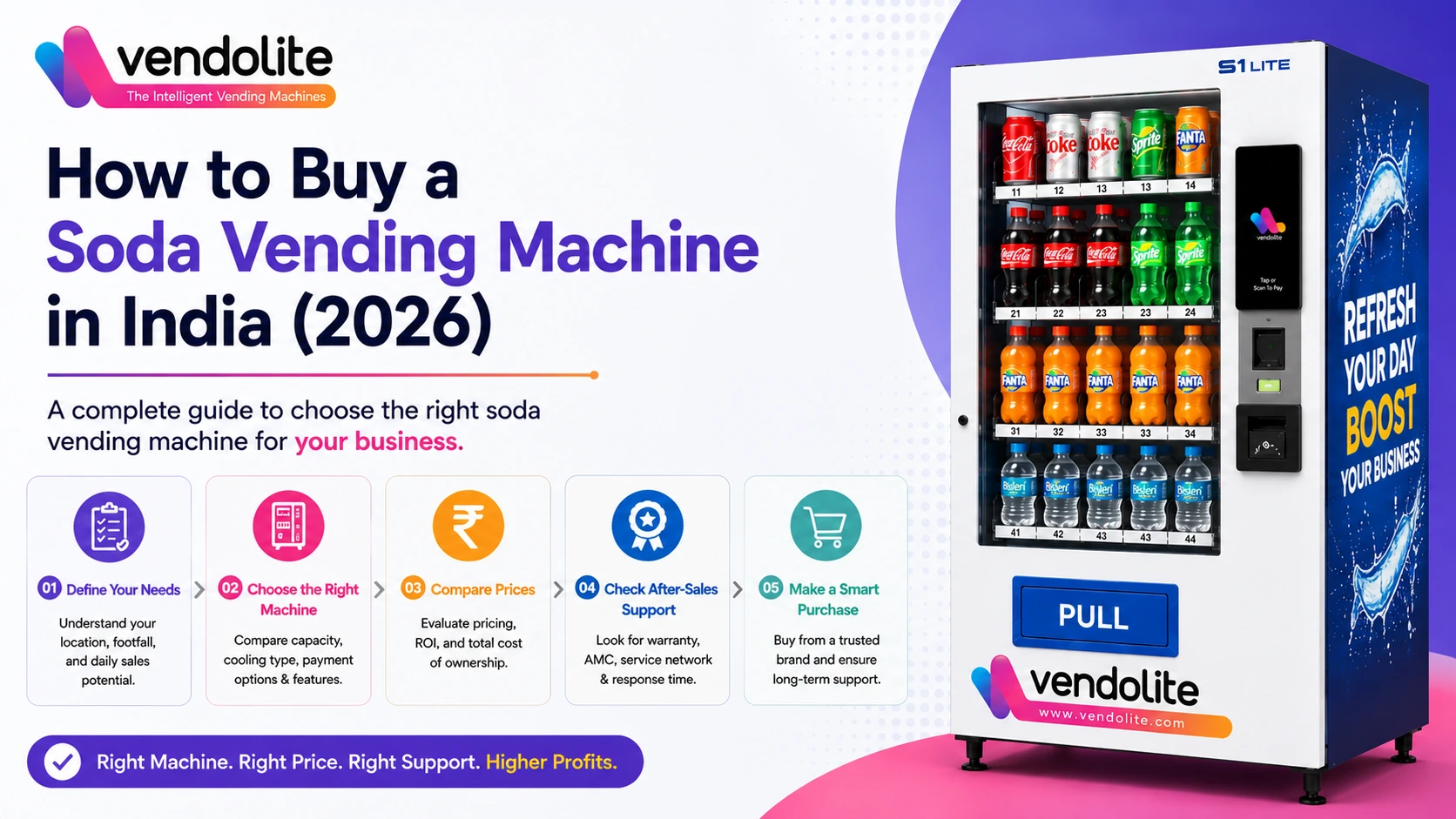
Buying a soda vending machine in India means weighing genuinely strong demand for chilled, ready-to-serve beverages against a handful of local operating realities: a near-universal preference for UPI payments, the country’s heavy heat load on refrigeration, and the easy availability of affordable labour for restocking. Get those three factors right and the unit pays for itself quickly; get them wrong and you are left carrying an idle asset. This guide walks through capacity, payment hardware, upkeep, and real 2026 pricing so you can buy with confidence rather than guesswork.
India’s long hot seasons, dense footfall across offices, campuses, hospitals, and transit hubs, and a young population that readily buys impulse refreshment together make automated beverage retail one of the steadier corners of the vending business. The decisive shift, though, has been payments. UPI processed record transaction volumes through 2025, and that single change removed the oldest friction point for any unattended machine: handling change. A buyer evaluating a soda vending machine today is therefore buying into a market where the demand is proven and the checkout problem is largely solved.
A short note on credibility before the specifics: the figures below reflect commercial machine norms and prices observed across Indian manufacturers and suppliers in 2026, not generic global averages. Beverage equipment behaves differently in Chennai’s humidity than in a temperate market, and the recommendations are written with that in mind.
Capacity is the first real decision when sizing a soda vending machine, because it sets both your restocking rhythm and your upfront spend. Choose a unit sized to expected daily traffic, then size up only if your location genuinely warrants it.
Indian machines broadly span two ends. Small units typically dispense around 150 to 180 litres per day, which is ample for a single office floor or a modest retail counter. At the other extreme, high-end models can serve well over 1,200 glasses daily, the kind of throughput a busy mall atrium or hospital lobby demands. Oversizing wastes capital and electricity; undersizing means staff are refilling the machine far too often.
Three formats cover almost every placement. A tabletop or mini unit suits pantries and small shops, and a compact tabletop model doubles neatly as a soda machine for office breakout areas where space is tight. A stand-alone, full-size unit is built for malls, hospitals, and airports where volume and a wide product face matter. A mobile or wheeled unit, mounted on a trolley, is the right call for events and street-side vending where the machine needs to move with the crowd.
Standard commercial multi-valve machines offer anywhere from 6 to 15-plus flavour options. More valves widen appeal but add cleaning lines, so match flavour count to whether you are serving a captive office crowd or a high-variety public footfall.
This is the section where Indian conditions diverge most sharply from imported buying advice, so weigh it heavily when specifying any soda vending machine.
Dynamic QR support for PhonePe, Google Pay, and Paytm is no longer optional; it is the default way customers expect to pay. A modern soft drink vending machine should generate a fresh QR for each transaction rather than display a static code, both for accurate reconciliation and for basic fraud safety.
In corporate offices and university campuses, pre-loaded RFID staff or student cards create a frictionless “closed-loop” experience and simplify monthly billing. If your placement is captive, this is worth specifying up front.
Cash and coins still earn their place in high-traffic public areas, but they carry a maintenance penalty: jam-prone mechanisms and physical collection routines. Offsetting that, insist on IoT telemetry. A machine that reports live sales and stock levels to your phone lets you restock on data rather than on guesswork, which is where the real operating savings live.
A soda vending machine is more demanding than a snack machine because syrup lines and refrigeration both need attention. Treat maintenance as a running cost you plan for, not a surprise.
Daily and weekly care is light but non-negotiable: wipe all touchpoints, keypads, and screens with food-safe disinfectant. Monthly work is heavier and matters most for safety, requiring a deep clean of syrup lines, product trays, and dispensing nozzles to prevent mould and bacterial growth. Because you are serving a consumable, this hygiene routine intersects directly with food-safety law; operators should confirm their licensing obligations with the Food Safety and Standards Authority of India (FSSAI) before going live.
On the technical side, clean the condenser coils and air filters every three to six months so the refrigeration unit can cope with India’s ambient heat, and inspect the CO2 lines and pressure regulators regularly for leaks. Finally, do not sign without at least a one-year warranty on parts and labour from a reputable Indian manufacturer; the cost of an out-of-warranty compressor failure dwarfs the premium for a proper support contract.
The headline number people search for is soda machine price, but the honest answer is a range, because capacity, cooling, and smart features move the figure substantially. The table below gives realistic 2026 brackets for the Indian market.
|
Machine tier
|
Estimated price range (INR)
|
Best suited for
|
|---|---|---|
|
Mid-range smart
|
₹2,00,000 – ₹2,30,000
|
Offices, shops, schools
|
|
Premium / custom
|
₹2,50,000 – ₹6,00,000+
|
High-volume malls, airports
|
For a fully featured, IoT-enabled commercial soda vending machine, Vendolite quotes a per-unit range of roughly ₹2 lakh to ₹6 lakh, with the final figure depending on model, capacity, cooling system, and customisation. That positions a Vendolite unit squarely in the smart-to-premium bracket, which is the band most offices, institutions, and high-footfall public sites should be shopping in anyway.
One more decision sits alongside price: buy versus rent. If you are still testing whether a location performs, renting lets you validate footfall before committing capital, and many buyers browsing a commercial soda machine listing or any soda vending machine for sale would be better served piloting on a rental first and converting to purchase once the numbers prove out. Conversely, if the site is established, outright ownership is cheaper over a two-to-three-year horizon. Either way, scrutinise a soft drink vending machine for sale the same way you would any capital equipment: total cost of ownership, not just sticker price.
The buy that works in India is the one matched to its location: right capacity for the footfall, UPI and QR built in, a serious maintenance plan, and a price tier that fits the site rather than the brochure. Settle those four and the machine becomes a quiet, around-the-clock revenue line.
If you would rather not assemble that checklist alone, Vendolite is worth a conversation. As India’s first vending machine provider, operating since 2013 with more than 6,000 machines installed globally, the company handles manufacturing, rental, retail, and franchise models end to end — from installation through restocking and support. Its beverage line ships with UPI, card, and QR payments, IoT telemetry, and cooling tuned for Indian conditions, and it supports placements from a single office pantry to a multi-site network under centralised control. For a buyer who wants a dependable soda vending machine without stitching together a vendor, an installer, and a service contract separately, that single accountable partner is the practical advantage worth paying for.
Because the machine dispenses a consumable beverage, food-safety registration generally applies. Confirm the exact category and fee with FSSAI for your scale of operation.
Consumption is driven almost entirely by the compressor and ambient temperature. A mid-range machine in a cooled indoor space is modest to run; the same unit in direct heat works harder and costs more, which is why coil and filter maintenance directly affects your power bill.
In high-footfall placements such as offices, colleges, hospitals, and transit hubs, low staffing needs and 24/7 availability typically deliver a short payback, provided the machine is sized correctly and kept stocked.
Soda vending machines in India cost Rs 2-6 lakh depending on capacity and cooling. Vendolite supplies refrigerated soda machines holding up to 300 beverages at 4°C, with touchscreens and UPI payments. Offices, gyms, theaters and transit locations are the strongest placements for beverage-focused machines.
Talk to our experts!