

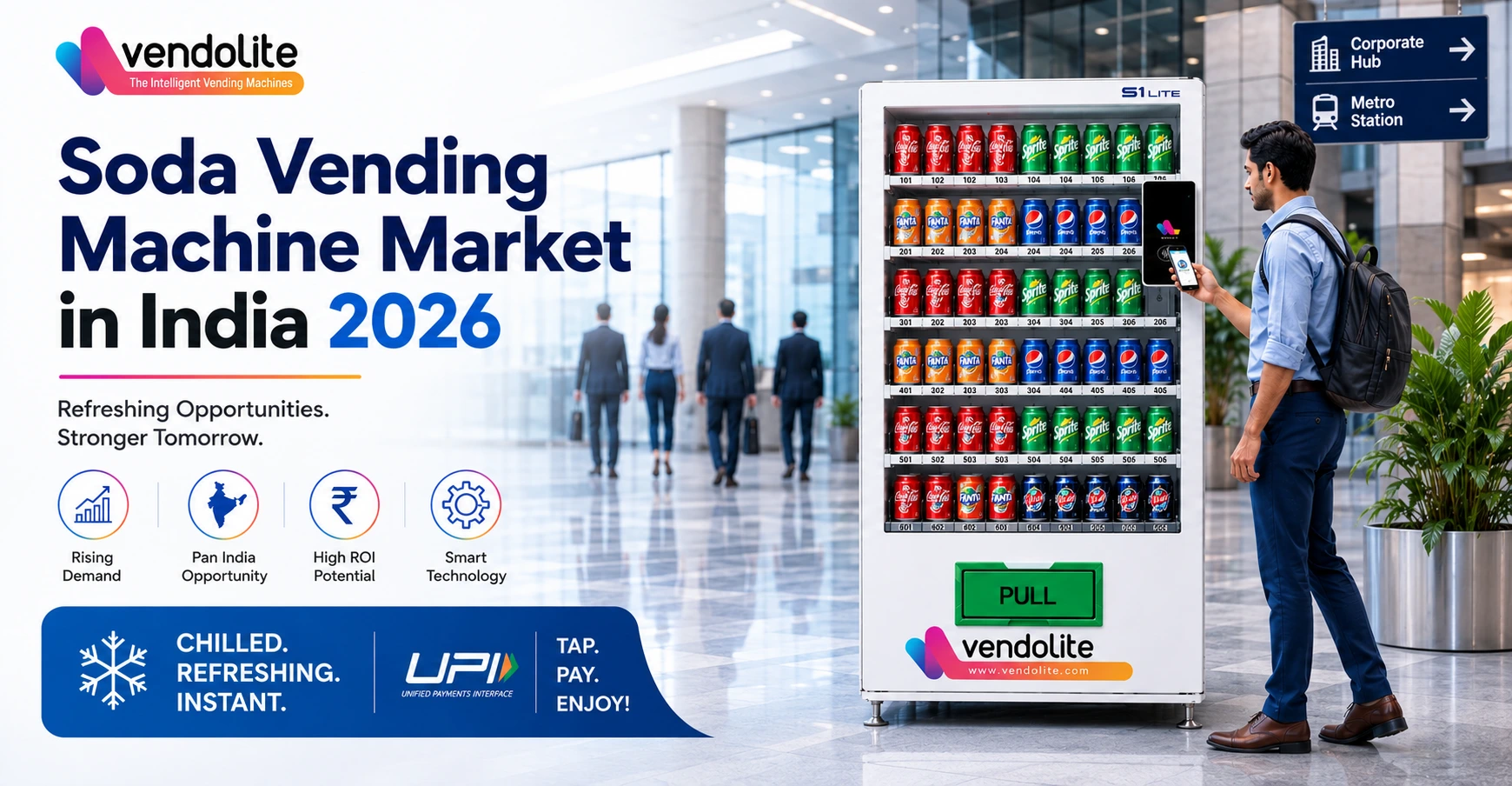
India’s retail and commercial beverage landscape is undergoing a rapid, structural transformation. Urbanization, evolving consumer habits, and a sharp rise in self-service formats have together created fertile ground for automated beverage dispensing to move from novelty to mainstream business infrastructure. The soda vending machine has emerged as one of the most compelling products within this ecosystem — drawing serious interest from investors, franchise operators, QSR chains, and beverage brands that want to own their last-mile consumer experience.
This article draws on market data, deployment trends, and technological developments to provide a comprehensive, current view of how this market is evolving and what it means for businesses operating in it or planning to enter it.
Before diving into vending specifically, it helps to set the stage by outlining India’s broader picture of carbonated beverage consumption. India ranks among the top five soft drink markets globally by volume. Annual per capita consumption of carbonated drinks has grown steadily over the past decade, supported by a young demographic profile – over 65% of the Indian population is under 35, with rising household incomes, and the rapid expansion of away-from-home food culture.
Organized foodservice formats, including quick-service restaurants, entertainment venues, corporate campuses, and transit hubs, collectively account for a growing and significant share of carbonated beverage purchases. These are precisely the environments where automated dispensing thrives, making India’s consumption structure a natural fit for the growth of vending.
The country’s climate is another underappreciated driver. With large parts of India experiencing heat indices above 40°C for several months of the year, demand for cold, carbonated beverages at points of convenience is not seasonal – it is near constant.
Choosing the right commercial vending machine is one of the most practical decisions in any beverage or foodservice business. Commercial-grade machines are built to handle constant, heavy use in busy public spaces. Unlike smaller or basic units, they are designed to dispense hundreds of soda bottles, cans, and snack items every day without any drop in reliability. That means every product is dispensed at the right temperature, in perfect condition, and consistently available whenever a customer needs it.
Several characteristics define machines that meet genuine commercial performance benchmarks:
For operators, these specifications are not luxury additions. They are the baseline requirements for running a reliable, revenue-generating vending operation at scale without incurring excessive service and maintenance overhead.
India’s carbonated beverage vending sector has recorded consistent year-on-year expansion, driven by three principal forces: growing operator adoption across organized retail and hospitality, declining hardware acquisition costs that have lowered barriers to entry, and increasing brand appetite for owned, managed dispensing infrastructure as an alternative to traditional distribution channels.
According to market research published by Mordor Intelligence, the overall Indian vending machine market is on a high-growth trajectory, with carbonated beverage dispensing among the fastest-expanding product subcategories. Analysts cite the combination of favourable demographics, expanding organized retail, and rapid adoption of digital payments as the three structural pillars supporting this trajectory.
The economics of operating a soda vending machine have improved measurably with the maturation of India’s digital payments infrastructure. UPI transaction volumes surpassed 13 billion per month in 2024, removing the friction that historically constrained vending adoption — namely, the dependency on coins and small cash denominations. Cashless vending is now a consumer expectation, not a differentiating feature. This shift alone has significantly expanded the addressable market, unlocking previously underserved locations and demographics.
The soda machine market in India has considerable momentum in 2026. The convergence of several macro-level shifts shapes it. Each of these shifts is independently significant; taken together, they represent one of the more compelling structural setups the Indian vending sector has seen.
India’s urban population is projected to exceed 600 million by 2030, creating a continuously growing pool of high-footfall commercial environments, shopping centres, metro transit stations, IT parks, mixed-use developments, and logistics hubs — that are structurally aligned with vending deployment. More people in more urban environments with higher disposable incomes means more daily consumption moments that vending infrastructure can capture.
The foodservice industry is undergoing its own reorganization at the same time. QSR chains and cloud kitchen operators are increasingly viewing managed vending as a cost-efficient beverage delivery format that reduces labor dependency, improves throughput consistency, and scales more predictably than traditional counter-service staffing.
Investment interest has also grown significantly. Private capital that once concentrated primarily on food technology and delivery platforms is increasingly flowing into vending infrastructure businesses, particularly those with managed-operator models, recurring revenue profiles, and proprietary IoT platforms. Machine leasing and revenue-sharing frameworks have made market entry accessible for a broader range of business operators, accelerating network growth beyond what the traditional capital-purchase model could achieve.
India’s organized retail sector has expanded its footprint into over 400 cities. Each new mall, transit hub, or campus development is a potential site for vending deployment. The pipeline of new organized retail and infrastructure projects slated for commissioning between 2025 and 2027 represents a substantial volume of addressable locations.
The FMCG sector’s pivot toward direct-to-consumer (D2C) distribution models has simultaneously made branded vending a viable channel for beverage companies that want to control the dispensing experience at the point of consumption — standardizing quality, capturing consumer data, and eliminating distributor margin erosion.
The diversity of environments in which commercial soda vending machine operators in India have established productive deployments is one of the most compelling indicators of the market’s maturity. Machines are no longer confined to airports, multiplexes, and five-star hotel lobbies. They now span a wide range of commercial verticals, each with its own distinct, well-tested deployment logic.
Large campuses and IT parks house thousands of employees who consume beverages throughout the workday. Vending offers employers a cost-efficient refreshment amenity that operates without staffing overhead, reduces wastage from overstocking canteen inventory, and provides employees with on-demand access around the clock. For operators, high-footfall captive environments with predictable consumption patterns translate into strong, consistent revenue per machine.
QSR chains and food court operators use dispensing infrastructure to standardize beverage quality across high-volume locations. Franchise operators particularly value the precision that controlled dispensing delivers — the same carbonation level, the same temperature, the same pour volume at every outlet, every time. It removes one of the most variable elements in beverage service quality.
Mid-segment hotels have adopted soda dispensers in lobby areas, poolside facilities, and gym annexes as a guest experience enhancement that requires minimal operational management. For budget properties, it provides a refreshment offering that would otherwise demand dedicated staffing or a complex supply arrangement with a beverage brand.
Colleges, professional coaching centres, and boarding schools have emerged as a growth segment, driven by student demand and a wave of institutional-level canteen modernization programs. The captive, recurring nature of student populations makes these locations economically attractive to vending operators on revenue-share models.
Entertainment venues benefit from a revenue-sharing deployment model that converts high-footfall corridors into productive beverage retail points. The ability to serve demand during peak hours — when traditional counters are overwhelmed with queues — is a direct and measurable revenue advantage for venue operators.
Post-workout hydration demand has created a niche for dispensers in fitness environments, particularly for operators offering sparkling mineral water, sugar-free sodas, or electrolyte-based carbonated variants. The health-conscious consumer segment is driving formulation innovation, expanding the product range viable for vending deployment.
Collectively, these use cases illustrate that the addressable opportunity for a well-deployed soda vending machine in India extends far beyond traditional market definitions. The total addressable market is as wide as India’s organized commercial real estate footprint — and that footprint continues to grow.
The latest commercial dispensing equipment available in India bears little resemblance to the coin-operated units that defined the category two decades ago. Technology has transformed every layer of the product stack, from mechanical dispensing components to back-end analytics platforms — and the pace of innovation is accelerating.
Real-time connectivity is now a standard feature in premium commercial units. Operators can monitor machine status, inventory levels, sales data, fault codes, and maintenance alerts from a centralized dashboard without physically visiting each location. For operators managing large fleets across multiple cities, remote visibility dramatically reduces both maintenance costs and mean time to resolution when issues occur.
Advanced IoT implementations have moved beyond passive monitoring toward predictive maintenance — using sensor data and machine learning models to identify components at risk of failure before they fail. This proactive approach is particularly valuable in high-revenue locations, where even a few hours of downtime can result in significant lost sales.
AI-based demand forecasting is emerging in enterprise deployments, enabling operators to model consumption by location, time of day, day of week, and seasonal pattern. This intelligence supports dynamic pricing strategies and optimized restocking schedules, improving margins without adding manual operational complexity.
Localized, multilingual interfaces have significantly broadened the soda vending machine’s user base, making the format viable in markets beyond English-dominant urban centres. Hindi, Tamil, Telugu, Kannada, and other regional-language interfaces are becoming standard requirements for operators deploying outside metro-tier 1 cities.
Newer compressor designs and pre-cooling architectures have reduced electricity consumption by up to 30% in units introduced over the last three years compared to equivalent older models. For operators managing high-throughput locations, this translates into meaningful reductions in monthly operating costs and a more favorable payback profile on hardware investment.
The success of beverage vending is part of a broader reappraisal of what the Commercial vending machine can deliver within India’s retail context. Retailers, brand owners, and commercial property operators now view vending infrastructure as a legitimate, stand-alone revenue channel rather than a secondary amenity occupying unused floor space.
This reappraisal has catalyzed a wave of branded vending activations — machines wrapped in brand-specific liveries, displaying digital promotional content, and integrated into below-the-line marketing programs. For beverage brands, a branded dispenser installed in a high-footfall location is simultaneously a distribution point, a brand experience touchpoint, and a first-party data asset. Consumer interaction data captured through connected dispensers — what is chosen, when, at what price point, with what dwell time — is commercially valuable in a way that traditional distribution data is not.
For commercial property owners managing corporate parks, retail developments, and transit facilities, vending infrastructure enables monetization of underutilized floor space in corridors, lobbies, and parking areas with zero inventory risk through a revenue-sharing arrangement with a qualified vending operator.
This convergence of brand interest, real estate economics, and retail innovation is one of the reasons analysts are describing the Indian vending market’s growth as structural rather than cyclical.
No credible market analysis is complete without an accurate account of the friction that exists alongside the opportunity. The Indian soda vending sector faces several structural challenges that deserve honest acknowledgment.
It remains the most commonly cited operational concern among fleet operators. India’s geographic scale means that maintaining machines in peak operating condition across distributed locations requires dense service coverage — something that demands significant infrastructure investment and is difficult to sustain without the right operational foundation in place.
Non-metro markets affect refrigeration performance and machine uptime in ways that urban-based operators do not always anticipate. Voltage fluctuations and intermittent outages require investment in surge protection and backup capacity, which adds to the initial capital outlay.
Consumer familiarity
While machine-dispensed beverages are rapidly improving in metropolitan centres, they still require investment in education and sampling in smaller cities where the format is new. First-time users in unfamiliar markets benefit from clear on-machine guidance and, in some cases, direct sampling activations to drive initial trial.
These are solvable challenges, and experienced operators have built proven playbooks for each. They are not reasons to avoid the market — they are reasons to enter it with the right partner and with realistic expectations about the operational investment required.
When it comes to scale, operational reliability, and depth of experience in India’s carbonated beverage vending space, Vendolite stands alone. With over 6,000 machines installed across the country, Vendolite has built India’s largest commercial soda vending machine footprint — spanning corporate campuses, QSR chains, retail developments, hospitality venues, educational institutions, entertainment complexes, and transit infrastructure.
Vendolite machines are designed with the specific demands of the Indian operating environment at the core of their engineering. They are built to handle voltage fluctuations, elevated ambient temperatures, and the significant variation in water quality that exists across different cities and regions. Every unit is constructed to FSSAI compliance standards and engineered to sustain continuous high-volume operation without performance degradation over multi-year deployment cycles.
What separates Vendolite from smaller market entrants is the depth and reach of its post-installation infrastructure. A machine is only as commercially valuable as its uptime, and Vendolite’s nationwide service network ensures that operators experience minimal downtime and maximum revenue continuity. The company’s real-time monitoring system enables proactive fault identification — often resolving issues before operators even become aware of them.
Vendolite’s engagement model extends well beyond equipment supply. The company provides comprehensive operator support from initial site evaluation and installation planning through to digital performance monitoring, restocking logistics guidance, and assistance with compliance documentation. For franchise operators and institutional buyers, this turnkey approach removes the operational complexity that has historically been the primary barrier to scaling vending networks with confidence.
Vendolite’s IoT-enabled platform gives operators real-time visibility into sales performance, machine health, revenue analytics, and consumption trends — all accessible via a mobile-optimized dashboard. This intelligence layer empowers operators to make faster, better-informed decisions about fleet management, menu configuration, pricing adjustments, and expansion priorities.
Whether you are a restaurant group looking to standardize beverage service quality across 50 locations, a real estate developer seeking to monetize lobby space at zero inventory risk, a hospitality operator enhancing the guest refreshment experience, or an entrepreneur entering the vending franchise model for the first time, Vendolite brings the track record, infrastructure, and support structure to help you succeed.
With 6,000+ machines already running across India, Vendolite is not just participating in this market’s evolution; it is driving it. It is defining it.
📞 Talk to a Vendolite deployment specialist today and find out how easily your next vending location can be up and running.
The evolution of the soda vending machine in India is not a passing trend — it is a structural shift in how beverages are distributed, consumed, and monetized at scale across the country’s commercial landscape. Urbanization, digital payment infrastructure, changing consumer expectations, improving unit economics, and a growing institutional appetite for managed vending solutions are all moving in the same direction simultaneously.
For businesses entering the market now, the combination of proven technology, established deployment models, and a rapidly expanding addressable base of high-footfall locations represents a compelling and timely proposition. Those who move early, invest in quality equipment, and partner with operators who understand the local landscape will shape the next decade of India’s commercial vending story.
The question is no longer whether automated beverage dispensing has a viable future in India. The market has already answered that decisively. The question now is: what role will your business play in it?
This article is intended for business operators, investors, and decision-makers evaluating the Indian commercial beverage vending market. All market projections referenced are based on published third-party research. For deployment-specific guidance, consult a qualified vendor of vending infrastructure.
India's soda and beverage vending market is expanding steadily as offices, transit hubs and institutions adopt automated retail, driven by UPI payment ubiquity and rising demand for 24/7 convenience. Cold beverages are among vending's highest-velocity categories. Vendolite's installed base reflects this, with beverage machines among its most deployed formats.
The machine can hold pens, notebooks, markers, geometry sets, and other daily essentials.
Yes, educational spaces are the most common installations, ensuring students never miss essentials.
Customers can pay using cash, cards, UPI, or mobile wallets.
With IoT-enabled monitoring, restocking is efficient and based on real-time usage.
Talk to our experts!