

Retail is being reshaped by technology faster than at any point in the last two decades. The global retail automation market is projected to expand at roughly 10–11% annually through 2030, according to Grand View Research, as brands look for ways to sell closer to the consumer without the overheads of conventional stores. Interestingly, one of the oldest formats of automated retail — the humble vending machine — is only now getting the technology upgrade it needed to compete seriously.
That upgrade is changing how brands think about distribution. Instead of treating machines as a convenience add-on, forward-looking companies are now deploying the vending machine as a retail channel in its own right — with dedicated merchandising, data dashboards, and revenue targets attached to every unit.
Coca-Cola set the tone for the industry’s next chapter at World Expo 2025 in Osaka, where it unveiled the world’s first hydrogen-powered vending machines in partnership with Fuji Electric — 58 machines running on replaceable hydrogen cartridges that generate their own electricity. Months later, the beverage major went a step further with AI-driven vending machines in New Zealand, built to deliver a faster and more personalised purchase for every shopper who walks up to the machine.
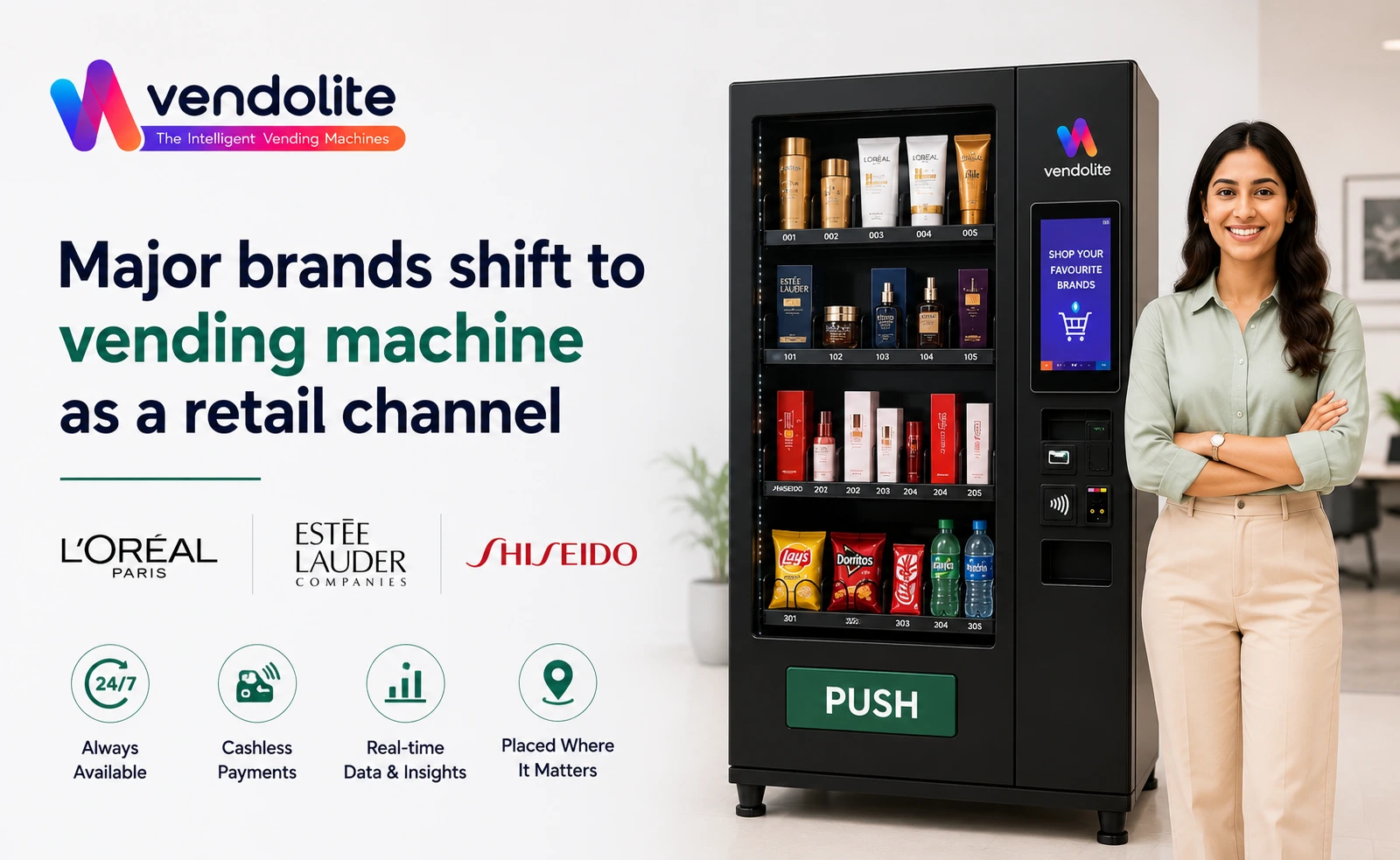
The beauty industry is moving just as decisively. L’Oréal, Estée Lauder, and Shiseido have all deployed branded vending machines in high-traffic global hubs, many equipped with AI-powered skin analysis and augmented reality try-on features that bring a counter-level experience to an unmanned unit. The category they are building is substantial in its own right — cosmetics vending was valued at $1.8 billion in 2025 and is projected to reach $4.1 billion by 2034. When the world’s largest beverage and beauty companies invest in machine-led selling, it signals that vending has moved from experiment to strategy.
Vending predates the internet by nearly a century, yet it never scaled the way e-commerce or quick commerce did. The reasons were structural: cash-only payments, no visibility into stock or sales, and a purely transactional buying experience. Remove those constraints, and the format’s core strengths become obvious — 24/7 availability, minimal staffing, tiny footprint, and placement exactly where demand exists.
That is why the vending machine as a retail channel is gaining momentum in India specifically. Offices, IT parks, metro stations, hospitals, gyms, and residential communities offer captive, high-frequency footfall that traditional stores cannot serve economically. For a brand, a connected machine in these locations functions as a micro-store that never closes.
Expectations have shifted from “does it dispense?” to “does it sell like a store?” Two capabilities separate machines that merely exist from machines that perform.
These connected units combine a touchscreen interface, cloud connectivity, remote monitoring, and digital payments in a single unit. For the shopper, that translates into multi-product selection in one transaction, instant automated refunds when a dispense fails, multilingual screens, and support for offline transactions when connectivity drops. These features are no longer differentiators; they are the baseline a brand must meet if it wants repeat purchases at the machine.
Equally important is the overall vending machine consumer experience – lighting, planogram clarity, product freshness, and how quickly a complaint is resolved. Buyers who hit friction once rarely return to that machine, which is why leading operators now track machine-level satisfaction the way stores track NPS.
Legacy machines operate as isolated boxes: nobody knows what sold, what expired, or what jammed until a route driver shows up. Connected machines flip this. Every transaction feeds a central dashboard, so operators can see which SKUs move at which locations, adjust pricing by time of day, and predict refill needs before a stockout happens. This data layer is what elevates the vending machine as a retail channel from a passive dispenser to an actively merchandised selling point — the same discipline a brand applies to shelf space in a supermarket.
Modern consumers move between apps, marketplaces, stores, and machines without thinking about channels. Brands have to meet them with the same consistency everywhere.
India is arguably the best market in the world for going cashless at the machine. UPI now processes well over 15 billion transactions a month, and QR-based payment is second nature to urban consumers. Going cashless removes the single biggest friction point of legacy vending – exact change – while also cutting pilferage, simplifying reconciliation, and speeding up each transaction.
Digital payments do more than replace coins. They create a transaction record tied to a time, location, and SKU.
That record lets brands run machine-level offers, cashbacks, and loyalty programmes — turning an anonymous purchase into a repeat customer relationship.
Automated refunds are the trust-builder here: when a failed vend is reversed to the buyer’s UPI account within minutes, hesitation about paying a machine disappears.
When machines plug into the same inventory, CRM, and analytics systems as a brand’s online store and physical outlets, vending stops being a silo. A shopper can discover a product on Instagram, buy it from a machine in their office lobby, and redeem a coupon from the brand’s app — one continuous journey. Integration of this kind is precisely what makes the vending machine as a retail channel viable within a larger commerce strategy rather than an experiment running on the side.
The financial case for the vending machine as a retail channel is straightforward. A machine requires a few square feet of space, no sales staff, and a fraction of the capital a store demands. Returns are driven by three levers: location quality, product-mix accuracy, and operational uptime – all three of which improve dramatically once machines are connected.
Placement remains the single largest success factor. A machine in a 2,000-employee IT park will outsell an identical machine in a low-traffic corridor several times over. Treating the vending machine as a retail channel means applying store-style site selection: footfall counts, dwell time, competing options nearby, and demand fit for the audience.
Corporate campuses, co-working spaces, hospitals, colleges, gyms, and transit hubs consistently deliver the strongest sales density in India.
Transit locations trade higher rentals for very high impulse-purchase frequency, making them ideal for beverages, snacks, and travel essentials.
Connected machines let operators validate a location within weeks using actual transaction data and relocate underperformers quickly, something a leased store can never do.
A small-format retail outlet in a metro city can cost ₹15–30 lakh to fit out before the first sale, plus monthly rent and staffing. A comparable vending deployment costs a fraction of that, goes live in days, and scales one machine at a time. For a brand testing new markets or products, the vending machine as a retail channel offers store-level presence at kiosk-level cost — with the option to expand or exit with minimal sunk investment.
Vendolite operates one of India’s largest smart vending networks, with 6,000+ machines installed across corporate offices, factories, hospitals, colleges, and residential communities. Each deployment comes with UPI-first cashless payments, real-time inventory and sales dashboards, automated refunds, and end-to-end operations – from placement analysis to refilling and servicing. Whether you are a brand seeking distribution or a facility looking to serve your people better, Vendolite makes the vending machine as a retail channel work from day one, without you managing a single refill.
Smart vending gives brands unattended, 24/7 selling points inside high-footfall locations that staffed counters cannot serve profitably. With digital payments, remote monitoring, and real-time sales data, a machine delivers store-like control at a small fraction of the operating cost.
Yes, in most use cases. A vending deployment avoids store fit-out costs, monthly staffing, and long lease lock-ins, while going live in days instead of months. Networks like Vendolite, with 6,000+ machines installed across India, also offer fully managed operations, so brands and facilities carry no operational overhead at all.
FMCG snack and beverage brands, packaged healthy-food companies, personal care and wellness brands, and D2C labels testing offline distribution see the strongest results. Any product that is compact, impulse-friendly, and frequently repurchased suits the format — and partners like Vendolite can match products to the locations where they sell best.
Connected machines share data with a brand's e-commerce, app, and store systems, so pricing, promotions, and loyalty stay consistent across every touchpoint. A customer can discover a product online, buy it at a machine near their workplace, and earn the same rewards - making vending a seamless physical extension of the brand's digital presence.
Brands use vending machines as a retail channel because they deliver 24/7 sales at a fraction of store costs, with dedicated merchandising, real-time sales dashboards and direct consumer data. Machines test new products, capture impulse purchases and extend reach into offices and transit hubs traditional retail can't economically serve.
Talk to our experts!