

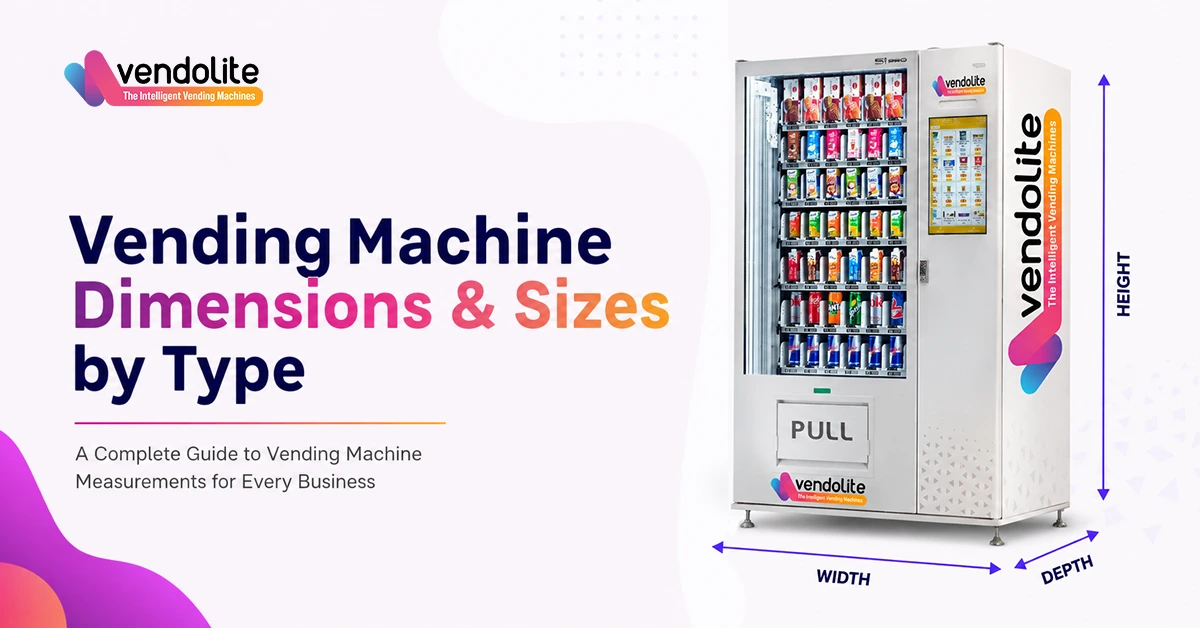
Before you order a machine, you need to know whether it will pass through your doorway, fit inside your lift and leave enough room for people to use it comfortably. Getting the vending machine dimensions right at the planning stage saves you from costly delivery-day surprises. This guide breaks down the exact height, width, depth and weight of every machine type in the Vendolite lineup, so you can plan your installation with real numbers instead of rough estimates.
A vending machine is one of the largest single pieces of equipment most offices, hospitals and campuses will ever move indoors. The typical vending machine dimensions in this lineup range from slim 882 mm wide cabinets to full-width 1477 mm units, and from 225 kg to 470 kg in weight. That variation decides where a machine can go, which entrance it comes through, whether the floor can carry it and how much circulation area remains once it is in place. Choosing by capacity alone, without checking the footprint, is the most common installation mistake buyers make.
The table below lists the exact specifications for all six Vendolite machine types, taken directly from the official model specifications.
|
Model
|
Height
|
Width
|
Depth
|
Weight
|
Capacity
|
|---|---|---|---|---|---|
|
S1 Pro
|
73 inch
|
50 Inch
|
31 inch
|
300 kg
|
60 slots, up to 300 items
|
|
S1 Lite
|
77.5"
|
37.5"
|
37"
|
225 kg
|
60 slots, up to 300 items
|
|
Hot Food
|
1940 mm
|
1220 mm
|
1015 mm
|
400 kg
|
80–160 products
|
|
Frozen
|
1960 mm
|
1163 mm
|
944 mm
|
470 kg
|
270–500 products
|
|
Locker
|
1940 mm
|
1080 + 397 mm
|
320 mm
|
220kg
|
19 selections
|
|
Elevator
|
1940 mm
|
1269 mm
|
795 mm
|
300 kg
|
300 pcs
|
Every model in the range stays between 1940 mm and 1960 mm tall, which means each one clears a standard commercial door frame in height. Width and depth are where the real differences appear, so those are the two measurements to check first.
Each machine type is engineered around what it dispenses, and the cabinet size follows from that. Here is what the numbers mean in practice.
The S1 Pro measures 1940 mm high, 1269 mm wide and 795 mm deep, weighs 300 kg and holds up to 300 beverages across 60 spiral slots. A 21.5-inch touch screen handles selection, the cabinet maintains 4°C to 25°C, and power draw is 442 W refrigerated or 44 W in normal mode. If you are comparing soda vending machine dimensions across brands, the S1 Pro is the reference point: its footprint and refrigerated beverage capacity represent the full-size class that most high-traffic locations install.
At 1940 mm high, 882 mm wide and 290 mm deep, the S1 Lite is the most compact cabinet in the range and, at 225 kg, the lightest. It keeps the same 60 slots and 300-beverage capacity as the S1 Pro while trimming nearly 400 mm of width, making it the natural choice for narrow corridors, small pantries and tight retail corners. It runs a 10.1-inch touch screen, draws 427 W refrigerated or 29 W normal, and uniquely in this lineup accepts bill and coin payments alongside cashless.
The hot food machine is 1940 mm high and 1220 mm wide, but its 1015 mm depth makes it the deepest unit in the range — plan the extra floor projection accordingly. It weighs 400 kg, holds 80–160 products, carries a 32-inch HD touch screen and uses a microwave heating module with water cooling to serve items from 4°C up to 70°C. Its 4000 W rating is the key installation detail, covered in the power section below.
At 1960 mm, the frozen machine is the tallest in the lineup, and at 470 kg it is also the heaviest, so floor loading deserves attention on upper storeys. The cabinet is 1163 mm wide and 944 mm deep, holds 270–500 products depending on item size, and maintains a constant −18°C behind three layers of vacuum glass that prevent fogging. A 49-inch HD touch screen doubles as a display and advertising surface.
The locker machine spans 1080 + 397 mm across its two modules — 1477 mm in total width — yet sits only 320 mm deep, giving it the smallest floor projection of any model. It stands 1940 mm high, offers 19 independent locker selections through a 21.5-inch touch screen, and suits PPE, pharmacy and cosmetics dispensing where items need secure individual compartments rather than spirals.
The elevator machine shares the S1 Pro cabinet — 1940 mm high, 1269 mm wide, 795 mm deep and 300 kg — but replaces spiral drop delivery with a conveyor system across its 60 slots and 300-piece capacity. That makes it the right pick for fragile or premium products like glass bottles and fresh food boxes, without changing your space planning.
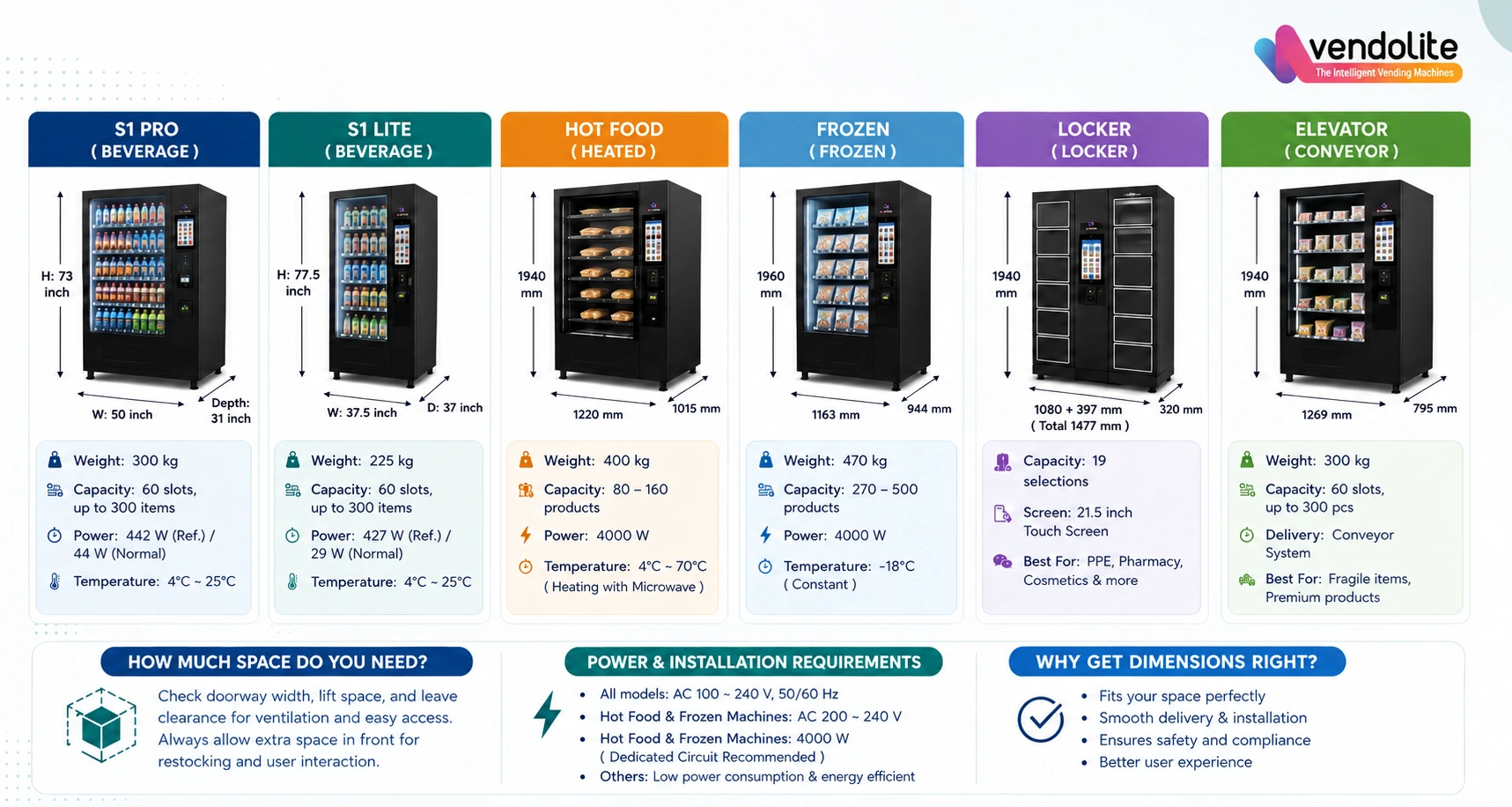
The cabinet footprint is only the starting point for planning your installation area. You also need clearance behind the unit for ventilation, room in front for the door to swing open during restocking, and enough approach area for users — including wheelchair users, for whom reach and operating-height guidance is published in the U.S. Access Board’s ADA accessibility standards. Measure your doorways, lift cabins and corridor turns against the vending machine dimensions above before delivery day: the 1269 mm wide S1 Pro, for example, enters most rooms sideways on its 795 mm depth rather than face-on.
All models accept AC 100–240 V at 50/60 Hz, with the hot food unit specified at AC 200–240 V. The refrigerated beverage machines are economical to run — 442 W for the S1 Pro and Elevator, 427 W for the S1 Lite — but the hot food and frozen machines are each rated at 4000 W, which in most Indian commercial buildings means a dedicated circuit rather than a shared pantry socket. Confirm the supply with your electrician before the machine arrives, not after.
Shortlisting by size alone is not enough; the smarter sequence is to match the product you want to sell to the machine type, then verify the footprint against your site. High-traffic beverage and snack points suit the S1 Pro, constrained corridors suit the S1 Lite, cafeteria replacements point to the hot food unit, ice cream and frozen ranges need the −18°C cabinet, secure item dispensing calls for the locker, and fragile goods travel safely in the elevator machine. Across all six machine types, the shared 1940 mm height band keeps door clearance predictable, so it is the width, depth and power figures within the vending machine dimensions that become the deciding factors.
With over 6,000 machines installed, Vendolite has planned placements in office towers, hospitals, factories, campuses and metro-city retail spaces across India and the UAE — and that experience is built into every specification above. Whether your site needs a slim 882 mm cabinet or a full 1477 mm locker wall, our team surveys your location, checks the vending machine dimensions against your access routes and recommends the model that fits both your space and your product plan. Get in touch with Vendolite for a free site assessment and find the machine that fits your business to the millimetre.
Full-size vending machines are typically 1940–1960 mm (76–77 inches) tall, 882–1477 mm wide, and 290–1015 mm deep. Across the Vendolite range, weights run from 225 kg to 470 kg depending on the machine type.
No. While every Vendolite model shares a height of around 1940 mm, footprints vary widely — the slim S1 Lite is just 37.5 inch, the hot food machine extends 1015 mm deep, and the locker machine spans 1477 mm across.
Leave about 150–300 mm behind the machine for ventilation and at least 300–600 mm in front for the door to swing open during restocking. Vendolite's team assesses this during the site survey before installation.
Depth varies more than any other measurement — from 320 mm on Vendolite's locker machine to 1015 mm on the hot food unit — and it determines the floor projection, airflow behind the cabinet, and whether the machine can pass through doorways sideways.
Measure the doorway, hallway, lift cabin, and every turn along the delivery path, not just the final spot. The 50 inch wide Vendolite S1 Pro, for example, typically enters sideways on its 795 mm depth rather than face-on.
Vending machine dimensions by type: snack/combo (S1 Pro) H: 73 inch, W: 50 Inch, Depth: 31 inch, 300kg; slim snack (S1 Lite) H: 77.5" W: 37.5" D: 37", 225kg; hot food 1940 x 1220 x 1015mm, 400kg; frozen 1960 x 1163 x 944mm, 470kg; locker 1940 x 1477 x 320mm. Allow ventilation clearance when planning installation.
Offices under 100 employees suit a slim machine like the Vendolite S1 Lite (37.5" wide, 37" deep); larger offices need the S1 Pro (50 Inch wide, 300-product capacity) or a combo machine covering snacks and beverages. Measure doorways and allow ventilation clearance — all standard machines stand about 1,940mm tall.
Talk to our experts!