

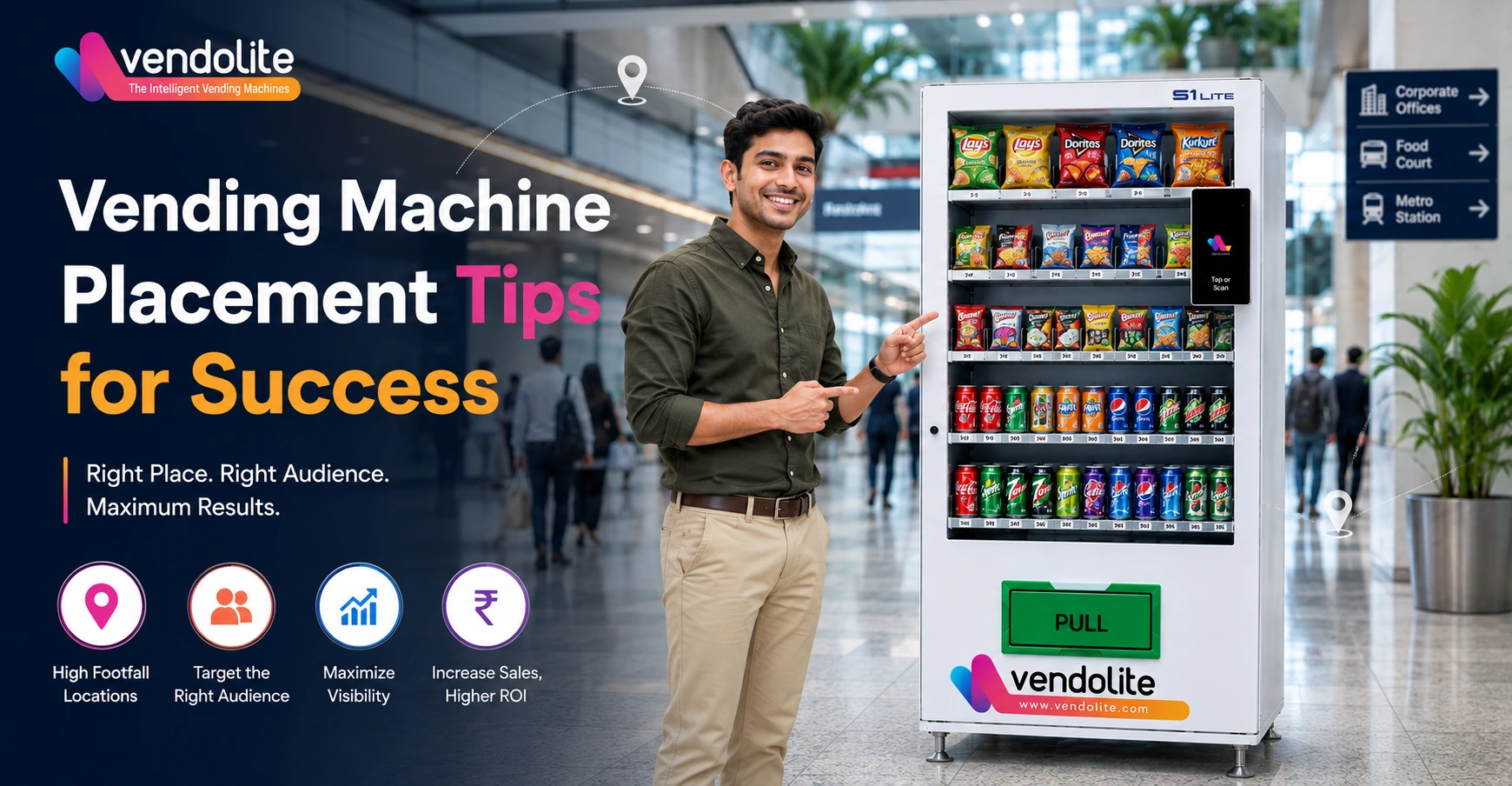
India’s vending industry is expanding at a pace few sectors can match. Yet, the single greatest determinant of whether a machine generates strong returns or sits underperforming is not its brand, product range, or payment technology — it is location. Thoughtful vending machine placement separates operators who build profitable, scalable businesses from those who struggle to recover their initial investment.
This guide is built for operators, entrepreneurs, and businesses at every stage — from those installing their first machine to those looking to optimise an existing fleet. It covers the complete process, location strategy, legal groundwork, and the practical insights that make the real difference in India’s 2026 vending landscape.
The economics of vending are straightforward: machines placed in the right environments generate consistent, passive revenue, while machines placed in the wrong ones do not — regardless of how capable the hardware is. India’s vending machine market is forecast to reach USD 1,623 million by 2030, according to research from Mordor Intelligence, and operators who invest in deliberate site evaluation consistently outperform those who treat placement as secondary to product selection.
Consumer behaviour has also evolved meaningfully in recent years. The post-pandemic preference for contactless, self-service purchasing has strengthened across age groups. UPI adoption has made cashless vending practical at scale, and out-of-home consumption — particularly in urban commercial environments — continues to grow year on year. All of these trends reward operators who place machines where target consumers naturally gather throughout the day.
The concept appears deceptively simple: find the people, understand what they need, and put the machine where they already are. Executing it well, however, requires a structured, evidence-based approach.
A common source of confusion for new operators is understanding precisely how the placement process unfolds from initial idea to a live, revenue-generating machine. This process involves four distinct stages, each requiring a specific set of decisions and actions.
Before approaching any property owner, operators must assess potential sites against objective criteria: estimated daily footfall, demographic alignment with the intended product range, proximity to competing food and beverage options, power availability, security provisions, and available physical space for machine installation. Sites that score strongly across all criteria make the shortlist; those with structural gaps — insufficient footfall, no accessible power source, or restricted access — are deprioritised before any time is spent in negotiation.
Once target sites are identified, operators initiate conversations with property owners or facility managers. The most effective approach emphasises mutual benefit — the machine adds measurable value to the property’s employees, visitors, or residents while generating revenue for the operator. Presenting data on projected usage rates, hygiene standards, and the service model (restocking schedules, maintenance response times) significantly improves the probability of a successful negotiation.
After an agreement is reached, the machine is delivered, positioned according to the agreed placement zone, connected to a power source, configured with the product range, and tested across all core functions — dispensing, payment processing, and remote connectivity. A brief soft-launch period allows operators to identify early friction points before full deployment.
Vending is not a set-and-forget model. Sales data from connected machines should be reviewed regularly to identify fast-moving products, adjust pricing, flag underperforming SKUs, and plan restocking runs efficiently. IoT-enabled remote monitoring reduces fault response times and ensures machines remain in revenue-generating condition across their deployment lifecycle.
The top-performing locations share three core characteristics: they attract a defined, consistent population of users; that population has a clear, recurring need for accessible food, beverages, or snacks; and the location lacks convenient alternatives. The following verticals consistently deliver the strongest returns for Indian vending operators.
Large corporate campuses and technology parks are among the most productive vending environments in India. Employees need refreshment throughout the workday — during breaks, before meetings, and after the lunch hour — and the captive, time-pressed nature of the workforce drives consistent daily transaction volumes. Tech parks in Bengaluru, Hyderabad, Pune, Chennai, and the NCR region are particularly strong deployment environments, often housing thousands of employees across single campuses where a single well-placed machine can generate predictable revenue six days a week.
Colleges, professional training centres, engineering institutes, and boarding schools represent a fast-growing demand segment. Students and faculty are on campus for extended periods, canteen queues are a known friction point, and the younger demographic is highly comfortable with digital payment formats. Machines positioned near library entrances, hostel common rooms, and sports facilities tend to generate the most consistent daily traffic.
Hospitals and clinics house an inherently captive population — staff working long and irregular shifts, patients recovering over extended stays, and visitors who may spend hours on the premises. All three groups benefit from what vending delivers: quick energy, hydration, and accessible snacks at hours when hospital cafeterias may be closed. Around-the-clock availability is a genuine operational advantage in this vertical.
Retail developments and multiplex cinemas attract high daily footfall with concentrated dwell time. Machines positioned in breakout zones, near food courts, or along corridors between anchor stores capture impulse purchase demand from shoppers who do not want to queue at a service counter. Revenue-sharing placement models work particularly well in these environments and are increasingly the standard arrangement.
Urban apartment communities with 100 or more units, shared gym facilities, and active community spaces are an emerging high-growth segment. Residents increasingly prefer accessible vending for late-night or early-morning needs, and the predictable resident population creates a stable baseline demand. Fitness centres benefit specifically from post-workout hydration and nutrition demand, making them suitable for product ranges that include energy drinks, protein bars, and sparkling water.
Foot traffic is a necessary condition for vending success, but it is not a sufficient one on its own. The commercial value of such a location depends on two additional factors: the quality of that traffic (are these people in a position to stop and make a purchase?) and the availability of alternatives (are there competing food and beverage options within immediate reach?).
A busy urban metro platform may record thousands of daily commuters yet offer low vending yield due to high competition from adjacent kiosks and the brief dwell time of transit users. A corporate cafeteria used by 400 employees with a structured 15-minute break window, however, creates reliable demand with minimal alternatives — a far more productive commercial environment despite lower raw footfall.
When evaluating locations, operators should go beyond raw traffic counts and assess dwell time. People who linger in waiting rooms, common areas, gym lobbies, or hospital corridors are significantly more likely to engage with a machine than those passing through. Every effective vending machine placement decision begins with this distinction between passing traffic and captive traffic.
In practice, operators should visit shortlisted locations at different times of day and across multiple days of the week, documenting footfall and observing existing purchasing behaviour at nearby refreshment points. The observational data gathered through this process is far more reliable than estimates and forms the evidential foundation for productive negotiations with property managers.
Starting in vending involves navigating a high volume of concurrent decisions — what machine to acquire, what to stock, where to place, what pricing to set, and how to structure the property arrangement. The following guidance is designed to reduce that uncertainty and give first-time operators a structured starting point.
New operators should prioritise locations with established performance track records: corporate offices, educational institutions, and healthcare facilities consistently deliver the most predictable returns across India. Experimental or unconventional locations — standalone outdoor spaces, low-occupancy buildings, or niche venues without an established refreshment culture — are better suited to experienced operators who can absorb underperformance while managing a larger fleet.
A machine that is difficult to find or inconvenient to reach will not generate sufficient transactions, regardless of product quality or pricing. Position machines in clearly lit areas at the natural height of adult eye level, close to existing footfall paths, and with enough physical clearance for users to stand comfortably during a transaction. The most strategically selected location in a building is undermined by poor internal positioning — a machine tucked behind a pillar or accessible only through a service corridor will always underperform its potential.
The property manager or facilities head who approves a placement will also be the first point of contact when operational issues arise — power interruptions, access restrictions, or complaints from building occupants. Investing time in establishing a respectful, professional relationship before any agreement is signed makes every subsequent operational conversation significantly more productive.
Before committing to a second or third machine, analyse the sales data from the first deployment with care. Identify which products are performing well, which are sitting unsold through consecutive restocking cycles, and what times of day drive the majority of transactions. Use these findings to make more informed decisions at the next location rather than simply replicating the initial setup without evidence.
This document sets out the legal and commercial framework governing the relationship between the machine operator and the property owner. Getting the agreement right protects both parties and prevents the most common sources of placement disputes from escalating into operational disruptions or financial losses.
A well-drafted agreement defines the placement zone (the exact location within the property where the machine will be installed), the duration of the arrangement and its renewal terms, the revenue-sharing or commission structure, responsibilities for machine maintenance and product restocking, liability provisions for machine damage or theft, electricity cost responsibilities, and the notice period required by either party to terminate the arrangement. Clarity on each of these points at the outset eliminates the most common causes of conflict down the line.
Commission rates in Indian vending placements typically range from 0% (free placement, common in corporate environments where the machine is positioned as an employee benefit) to 15–25% of gross sales in high-value commercial locations such as retail malls and transit hubs. Operators should evaluate commission structures against projected monthly sales volumes, not solely in percentage terms, to ensure the overall arrangement remains commercially viable.
Agreements that lack a defined placement zone (leaving the property owner free to relocate the machine without consent), do not specify a minimum termination notice period, are silent on electricity cost responsibilities, or omit liability provisions for machine damage, represent meaningful commercial risks. If an agreement does not address these areas, request specific amendments before committing. A property manager who is unwilling to formalise these standard clauses is itself a meaningful signal about the quality of the working relationship to follow.
For operators new to the market, managing the full placement process independently — identifying sites, approaching property owners, negotiating agreements, and coordinating installation — involves a steep, time-consuming learning curve. A professional service accelerates this process considerably by bringing established property relationships, market intelligence, and operational infrastructure that individual operators would otherwise need years to develop.
A quality service offers site identification and shortlisting based on the operator’s target vertical and budget, introductions to property managers through existing relationships, support in structuring and reviewing placement agreements, and coordination across installation, commissioning, and ongoing maintenance. The best providers also deliver access to performance data and analytics that enable operators to make evidence-based decisions about fleet expansion and product optimisation.
Before engaging any provider, operators should request references from existing clients, evidence of successful placements in their target verticals, and a transparent description of the service fee structure. Providers that cannot articulate a clear, documented process or are unwilling to supply operator references are best avoided, regardless of their pricing or marketing claims.
Acknowledging the genuine difficulties in vending machine placement is not pessimism — it is the foundation of realistic planning and sustainable business development. Several structural challenges consistently affect operators across India.
Property owner hesitation is more common than most guides acknowledge. Building managers are often cautious about commitments that create ongoing operational obligations, raise hygiene or liability concerns, or may generate complaints from building occupants. Operators who approach these conversations with professional documentation, prior deployment references, and a clearly articulated service model overcome this resistance far more effectively than those who rely solely on verbal pitches.
Power supply reliability in tier 2 and tier 3 cities requires operators to account for surge protection and backup connectivity, which add to initial setup costs. Internal visibility loss after installation is a frequently overlooked risk — furniture changes, new signage, or building reorganisations can block the agreed placement zone after the machine is live, making written zone definitions in the agreement essential rather than optional.
Seasonal demand variation disproportionately affects specific verticals. Educational institutions, for instance, experience significantly reduced transactions during examination breaks and semester holidays. Operators who build these lower-revenue periods into annual cash flow projections manage the seasonality without surprise; those who do not often miscalculate their expansion timelines.
For operators who want to build a profitable vending business without navigating the full complexity of site selection, agreement negotiation, and fleet management in isolation, Vendolite provides the complete infrastructure to accelerate the journey. With over 6,000 machines installed across India and a decade of deployment experience across every major commercial vertical, Vendolite has supported more vending machine placement operations across more cities and property types than any other provider in the country.
Vendolite’s operational footprint spans corporate campuses, retail developments, educational institutions, healthcare facilities, hospitality venues, and public infrastructure across India’s tier 1 and tier 2 cities. This scale reflects an accumulated network of property relationships, performance benchmarks, and operational learnings that directly benefit every operator Vendolite supports — from their first machine to their fiftieth.
Vendolite’s placement support covers every stage of the deployment journey. The company’s site evaluation team assesses shortlisted locations against proven performance benchmarks, facilitates introductions to facilities managers at target properties, assists with agreement structuring and legal review, manages installation and commissioning, and delivers ongoing IoT-enabled monitoring of machine health and sales performance across the operator’s fleet.
Every operator working with Vendolite gains access to a mobile-optimised performance dashboard that provides real-time visibility into sales, machine status, and revenue analytics — enabling them to make faster, better-informed decisions on product mix, pricing, and expansion priorities.
Whether you are placing your first machine or scaling toward a 50-location portfolio, Vendolite’s infrastructure, relationships, and track record ensure that your placement strategy is built on a foundation that consistently delivers
Secure the best vending locations by targeting high-footfall sites — IT parks, hospitals, colleges, gyms and transit points — and offering site owners revenue share or free employee amenities. Verify footfall personally at different hours. Vendolite's placement guidance and VMS data help operators evaluate and rank prospective locations.
The machine can hold pens, notebooks, markers, geometry sets, and other daily essentials.
Yes, educational spaces are the most common installations, ensuring students never miss essentials.
Customers can pay using cash, cards, UPI, or mobile wallets.
With IoT-enabled monitoring, restocking is efficient and based on real-time usage.
Talk to our experts!